
WEBINAR ON-DEMAND
From Rigid To Resilient
Why Enterprises Need Modular Commerce Now

Enterprise commerce is at a turning point. Legacy systems are rigid and full replatforms are risky, but the pressure to evolve is greater than ever. So what’s the path forward?
Modular commerce lets enterprises innovate without disruption. In this expert-led session, we dive into how composable strategies empower brands to integrate new capabilities, move faster, and scale smarter—without losing control of what matters most.
Learn how to refine your commerce approach and build resilience as retail enters a new era.
What You’ll Learn in This Session:
- Agility Without the Overhaul: How to innovate and scale without tearing everything down.
- Smarter, Seamless Integration: Ways to connect modern technologies into your current stack.
- Avoid Common Pitfalls: Why waiting to modernize could cost more in the long run—and how to act with confidence.
- Fuel Efficiency and Growth: How modular architecture improves performance across teams, systems, and customer experience.
- Build Future-Ready Commerce: The role of adaptability and scale in building long-term enterprise value.
Show Transcript
00:00:00:00 - 00:00:33:09
Tori (Online Retail Today)
Welcome everyone and happy Wednesday!. Thank you for joining us for From Rigid to Resilient Why Enterprises Need Modular ecommerce now, presented by Online Retail Today and sponsored by Orium Contentstack and Shopify. I'm Tori, the webinar coordinator of online retail today, and I'm excited to bring you this session on how a composable approach helps modernize commerce stacks while maintaining control over critical systems.
00:00:33:11 - 00:00:50:06
Tori (Online Retail Today)
I'm looking forward to hearing from Benjamin Woll, Tiffany Spizzo, and Jaime Santos Alcón and what I'm sure will be an insightful discussion. In case you missed any part of today's webinar, we will be recording this session and emailing it to you within the next 48 hours. You can also go to the registration page to access the recording.
00:00:50:08 - 00:00:57:10
Tori (Online Retail Today)
We’re going to send that link over to you in the chat right now. Up next.
00:00:57:12 - 00:01:18:20
Benjamin Woll (Orium)
Before we go any further, I want to thank Contentstack and Shopify for sponsoring this webinar and helping us to make this happen. Orium is a leading composable commerce consultancy and systems integrator in the Americas. They work with best in class technology partners to set strong and composable commerce foundations that support how brands serve customers across channels.
00:01:18:22 - 00:01:48:07
Benjamin Woll (Orium)
Content stack. The composable DXP leader empowers marketers and developers to deliver composable digital experiences at the speed of their imagination. Content stack has the industry's highest customer satisfaction rating and is a founding member of the MACH Alliance, advocating for best of breed, composable technology that is a microservice based API, first cloud native SaaS and headless. Last but not least, Shopify is the best commerce platform for scale on the planet.
00:01:48:09 - 00:02:02:10
Benjamin Woll (Orium)
The world's most innovative companies, including Brooklinen, Heinz, and Allbirds, choose Shopify for everything from online to retail to wholesale to social commerce. So thanks again to our sponsors. Up next.
00:02:02:12 - 00:02:07:10
Benjamin Woll (Orium)
Let's quickly get some technical things out of the way.
00:02:07:12 - 00:02:26:23
Benjamin Woll (Orium)
Don't hesitate to send in your questions throughout today's presentation for the Q&A session with our panelists at the end of the hour. You can do so by submitting your questions into the Q&A panel found in the bottom toolbar of this webinar window. The chat is also available for open discussion. Be sure to change the blue button in the chat box from hosts and panelists to everyone, so that you can join the conversation.
00:02:27:01 - 00:02:43:02
Benjamin Woll (Orium)
Please note that we will be using the Q&A panel for your specific questions, so make sure to send them there so they don't get lost in the chat. My wonderful colleague Tara will be fielding your questions today and she'll be happy to answer anything technical you might have. So feel free to pull off the chat, say hello and let her know where you're joining us from.
00:02:43:04 - 00:03:02:02
Benjamin Woll (Orium)
Closed captioning is available to enable this. Features like the more button in the bottom toolbar and select the Show Captions option. Lastly, if you have any audio issues in today's presentation, you may choose to dial in by phone, All dial-in information can be found in your webinar confirmation email from Zoom. And Tara can relay that to you at any point if you need it.
00:03:02:04 - 00:03:07:10
Benjamin Woll (Orium)
Up next.
00:03:07:12 - 00:03:29:14
Benjamin Woll (Orium)
Again today I'm really excited to hear from today's panelist, Jaime Santos Alcón, Manager of Solutions Architecture for the Americas at Contentstack Tiffany Spizzo, senior lead of strategic global alliances at Shopify, and Benjamin Woll, vice president as composable commerce at Orium. So without further ado, I'm going to pass over to Tiffany to kick us off for today's.
00:03:29:16 - 00:04:00:00
Tiffany Spizzo (Shopify)
Thanks, Tori, and welcome to everyone today. Again, my name is Tiffany Spizzo, and I help lead our global system integrator relationships and partnerships at Shopify. So today we're going to be diving into a topic that's more critical than ever the impact of delaying monetization on revenue and customer retention. As we all know, the commerce faces evolving rapidly and businesses that cling to outdated strategies and technologies risks not only losing revenue, but also facing significant customer attrition.
00:04:00:02 - 00:04:29:07
Tiffany Spizzo (Shopify)
So first things we want to first thing we want to do is kick things off with a poll. We'd love to find out kind of where your organization currently is and its commerce modernization journey. So if you could just take a moment, we'll take about a minute and just, fill out the survey on the screen and we'll take a look and kind of gauge where everyone's out on their digital transformation journeys.
00:04:29:09 - 00:04:44:12
Tiffany Spizzo (Shopify)
Don't be shy.
00:04:44:13 - 00:05:10:22
Tiffany Spizzo (Shopify)
All right. And thanks to everyone for going ahead and filling that out. So it looks like honestly, mostly everyone is really falling into that kind of beginning stage and exploring options and evaluating platforms. And, you know, I think that's perfect for today. And hopefully the content is relevant helps provide insight for you along that evaluation. Process. So and moving forward shifting market demands require adaptable commerce strategies all in one.
00:05:10:22 - 00:05:32:21
Tiffany Spizzo (Shopify)
Platforms are evolving, but agility remains a challenge. The risk of waiting is that enterprises are falling behind their competitors. 60% of enterprise say that rigid systems are slowing their growth. And the bottom line is that those delays equate to loss and revenue.
00:05:32:23 - 00:06:02:02
Tiffany Spizzo (Shopify)
Today, we're going to explore how shifting market demands require adaptable commerce strategies and the challenge enterprises face with all in one platforms is that while they're evolving, often they struggle to provide the agility needed in today's fast paced environment. We'll also share some examples of businesses that have made the shift and are along on their transformation journeys. We'll discuss the risks of waiting because, as I mentioned, enterprises that hesitate to adapt often find themselves falling behind their competitors.
00:06:02:04 - 00:06:22:05
Tiffany Spizzo (Shopify)
Now let's jump into our discussion around that point. And first I'd like to introduce Benjamin Woll from Orium. He'll share some insights on the services side and some of the risks that we're seeing in delaying change. Thank you Tiffany. Good day everyone. Glad to be here. The first thing I'll maybe say on this slide is, don't delay.
00:06:22:06 - 00:06:48:03
Tiffany Spizzo (Shopify)
Certainly you might not even realize you can begin to move towards more modular, architecture, even, starting something small, starting with maybe CMS or OMS, perhaps e-commerce engine. But begin to evaluate your modernization strategy as what are the pain points that you have and, begin to build a plan backwards from there. And maybe start with, a single a pain point or attacking it that way.
00:06:48:05 - 00:07:07:10
Benjamin Woll (Orium)
I've been doing this for a long time. We're a lead systems integrator for composable commerce solutions. If I can help make sense of any of this as you're going down your journey, don't hesitate to reach out. On LinkedIn. I'll start with some of the common pain points, that help to speak to what some of the key risks are with regards to delaying, your modernization.
00:07:07:12 - 00:07:31:15
Benjamin Woll (Orium)
The first, if you've if you've fallen in any of these, traps, they might be good signals, but the first would be slow innovation cycles. Putting in tickets with development teams, waiting on, marketing or content to be able to quickly adjust and change messaging to consumers. But ultimately, if you're releasing on a monthly basis, if you're struggling to release features and integrate features quickly.
00:07:31:17 - 00:07:53:01
Benjamin Woll (Orium)
That's certainly one common pain point. The next is when you're beginning to spend probably 70% of your costs just on operating the system and not driving incremental value. Looking at, you know, challenges you might be having with more rigid architectures. And largely tying a lot of that to maintaining them. Instead of building or enhancing them.
00:07:53:03 - 00:08:13:23
Benjamin Woll (Orium)
The third might be every time you want to integrate something, someone says that's going to take a month or that's going to take several weeks. Or being in an ecosystem that's quite limited with how they communicate to other platforms and applications. That's certainly another risk. What do these all culminate in? Certainly. Getting to market, in less than optimal timing.
00:08:14:01 - 00:08:31:08
Benjamin Woll (Orium)
Not being able to be able to meet customer experiences or having friction with your customers. And then ultimately ongoing higher tech debt and maintenance costs. That's certainly what we see for some of our customers. Not sure. I may what you see at Contentstack, but we'd love to hear some of your thoughts. Hey,
00:08:31:10 - 00:08:53:14
Benjamin Woll (Orium)
Thanks, Benjamin. My name is Jaime Santos Alcón. Like. Like Tori said, I'm originally from Spain. I wanted to add some personal color there in case you get an accent. So. So, yeah. Ben, like, you're spot on, right? Like, when I introduce content, like, she mentioned that, we were founders, co-founders of the MACH Alliance.
00:08:53:16 - 00:09:18:09
Benjamin Woll (Orium)
And when we did some research there, we we got some interesting metrics, right. We realized that, the more legacy systems that you have, the more money you spend on simply maintaining or upgrading or keeping up with, with the licenses of those systems as opposed to to putting the money into innovation or, you know, satisfying the needs of your customer base.
00:09:18:13 - 00:09:44:23
Benjamin Woll (Orium)
Right. One, one metric that we saw. And I think you mentioned it a little bit, was that half of the organizations using, you know, or delay in my math modernization, require at least one month to you know, put something new out or to, to cater for, for, a customer need. You know, and being behind, it's, you know, it's basically leaving revenue on the table.
00:09:45:01 - 00:10:07:22
Benjamin Woll (Orium)
And that's basically one of the biggest, biggest ways, right? You're kind of already late to the party. And if you don't modernize, you're going to continue to be to be late. The, you know, the the next, topic, I'll give it back to you, Tiffany. That's why we're here, right? We we see the those risks.
00:10:07:22 - 00:10:32:00
Benjamin Woll (Orium)
And, you know, there's, a better approach to to avoid those, those situations basically. Yeah. I mean, those are great points. And honestly, I think, you know, we're saying the same thing for Shopify as well. We're businesses just don't want to pay for the plumbing anymore. I think for a long time, you know, we've put so much money and so much effort into the infrastructure, into the plumbing of this architecture.
00:10:32:02 - 00:10:54:11
Benjamin Woll (Orium)
And the reality is that businesses really want to be able to now focus on the experience they're delivering for their customers. And with the introduction of things like orchestration layers, pre-built integrations, advanced APIs, we're allowing businesses to now be able to replace and update pieces that are needed over time. Instead of just doing these massive rip and replaces over and over again.
00:10:54:13 - 00:11:15:06
Benjamin Woll (Orium)
So I think you're you're completely right. Like the tech debt becomes an issue. And, we've got ways to solve for that. Now that allows people to move more incrementally. So kind of on that note, what does modernization look like and how do enterprise businesses get there in a way that allows them to do so without significant delays to their day to day operations?
00:11:15:07 - 00:11:45:16
Benjamin Woll (Orium)
I'm sure everyone's hearing the same buzzwords right now. Composable modular component ties. We're all talking and talking about the same thing. I think we talk in varying degrees, though, from microservices or kind of Lego blocks to more functional component parts that come together and really address business needs. At a core, we're talking about breaking apart these all in one monolith platforms that create growth barriers and in favor of a flexible architecture that allows you to customize and scale.
00:11:45:18 - 00:12:06:11
Benjamin Woll (Orium)
Hi, May I know we talked a little bit about this as well, but I know you've got cuz I'm kind of, you know, the separation of concerns on this as well that you can share. Yeah. Thanks. Evony like yeah. The modular it's also, you know, the you were using the term buzzwords, right? Like, separation of concerns is one of those, but also best of breed, right.
00:12:06:12 - 00:12:30:19
Benjamin Woll (Orium)
And, that's what, what I'm saying, our approach gives you, it allows you to, you know, utilize, the different technology stacks that are best for the job. As part of the, modular architecture. You can you can do that, right? But it's not only about, you know, separating concerns when it comes to functionality from a technology perspective, but also with the with the teams.
00:12:30:19 - 00:12:59:10
Benjamin Woll (Orium)
Right. Like the, the people involved building these solutions and working with these solutions. Benefit also from, from, from that modularity. Right now you have more specialized teams and, you know, and groups that can focus on, on also what they do best. Right. And, you know, I wanted to get your your opinion, Ben, on on what your thoughts on, are on, on, you know, having that specialization on teams and what do you see from, from the partner side as well?
00:12:59:12 - 00:13:19:06
Benjamin Woll (Orium)
Yeah, absolutely. One of the benefits here is you can, you know, begin to build teams based on what they're best at. I often say we can move away from this kind of five year old playing soccer where everyone needs to run towards the ball, understand everything all at once. One of the benefits of looking at a modular approach is you can start to build some of that knowledge over time.
00:13:19:06 - 00:13:49:10
Benjamin Woll (Orium)
You might have a front end, team that's great at deploying, new experiences for customers. Faster. You might have a team, that's more, you know, technically capable on the back end, building integrations, maintaining middleware applications, looking at speed, performance, that's all. Those things are super critical. And the benefit that we've seen in, when we help our customers with is help to advise on what team structures look like so you can get the best of the development teams, to help deploy solutions faster and market.
00:13:49:12 - 00:14:16:00
Benjamin Woll (Orium)
So that's what we see. I'd be curious. Definitely where Shopify is. Perspective, maybe tell us a little bit more how, Shopify is growing into more modular, extensible approach. Yeah, absolutely. I'd love to talk about our platform policy. And. All right, this may be news to some people. But Shopify is not a monolith. Much to the dismay of our competitors and some of the FUD that's out there, the perception that has been thrown around from time to time, to be frank, is not true.
00:14:16:02 - 00:14:40:07
Benjamin Woll (Orium)
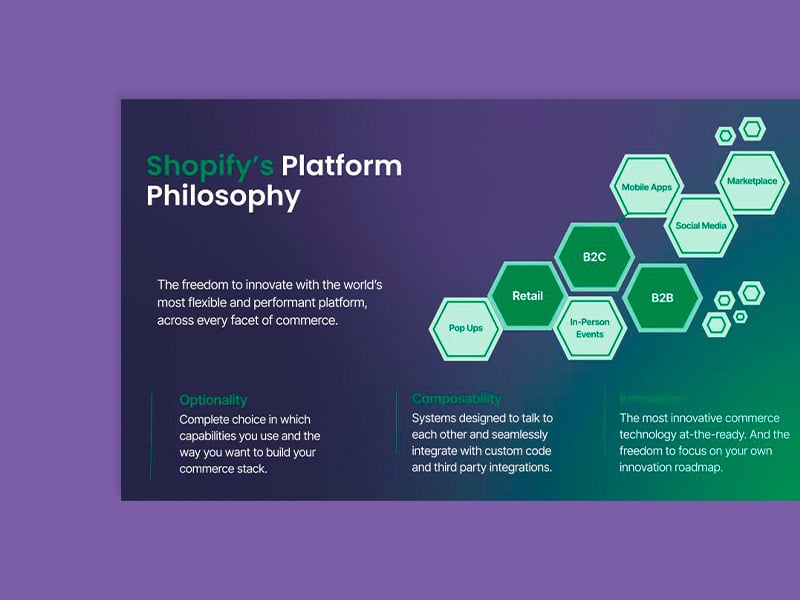
Shopify is really a flexible or as composable as you need it to be. It's not an all in one scenario. In fact, we pride ourselves on being flexible and composable across the whole spectrum of commerce B2B, retail, social commerce, you name it. Shopify anchors on three central concepts optionality, allowing you to choose which Shopify solutions and products you want and architect your own commerce stack.
00:14:40:09 - 00:15:08:13
Benjamin Woll (Orium)
Composability allowing you to seamlessly integrate with either custom code, third party systems. Creating a best for me solution. An innovation. Shopify is the most innovative commerce platform on the market. Shopify allows you to innovate with the most scale solutions in the market to create differentiated differentiation and value. And these benefits are woven into everything we do and build at Shopify.
00:15:08:15 - 00:15:29:22
Benjamin Woll (Orium)
Looking into optionality, in particular, we understand that your customers and commerce needs are constantly changing, which is why we give you the freedom to evolve between a full stack, headless, or using storefront APIs and SDKs to build apps and show up in new and unique ways where your customers may be, while others may offer 1 or 2 of these options.
00:15:29:22 - 00:15:53:02
Benjamin Woll (Orium)
Shopify offers full optionality to reduce unnecessary complexity. Go to market faster, and really give you the flexibility in your tech stack that meets the needs of your business and however you build it, you're always empowered to compose your tech stack the way that you want, so you get access to Shopify's best in class enterprise solutions across your entire tech stack.
00:15:53:04 - 00:16:16:07
Benjamin Woll (Orium)
You have limitless integration pathways, so if you want to swap out, say, Algolia for your search and discovery in place of Shopify search and discovery, you can do so. Or if you prefer, content stack for CMS or fluent for OMS. You can absolutely do that and leverage your best of breed, pre-built integrations that are available available to you through our ecosystem.
00:16:16:09 - 00:16:35:13
Benjamin Woll (Orium)
And that means you can always build your stack the way that you want it to, and do it faster than any other provider on the market. You know, I'd love to turn it over. Just get experience. Maybe starting with Ben, being on the services side to understand your experience and working with Shopify, as an extensible and composable platform.
00:16:35:15 - 00:16:52:20
Benjamin Woll (Orium)
Yeah, absolutely. In some cases, you can kind of have your, your cake and eat it too, depending on what the customer's, looking for, what their needs are. But certainly on the one end of the spectrum, if you were asked me five years ago, how composable was Shopify? And you asked me today, there's, two very different answers.
00:16:52:22 - 00:17:17:09
Benjamin Woll (Orium)
We have seen certainly a lot of growth. And ultimately, you know, five years ago, there may be an API internally of a system used. And today they're they're being exposed by default for customers if they want to build, applications at enterprise scale. And, and, look at headless deployments. On the other end of the spectrum, though, for a lot of customers, in some cases, looking at the, traditional deployment options makes sense.
00:17:17:13 - 00:17:43:17
Benjamin Woll (Orium)
So I think it's about identifying what your business needs, putting together, best of breed architecture, depending on, you know, build where it makes sense to build by, where it makes sense to buy, and in some cases both at once. But I would say certainly over the last few years, Shopify has given me the flexibility to pull from the ecosystem, build build integrations or select integrations, deploy things quickly.
00:17:43:19 - 00:18:09:16
Benjamin Woll (Orium)
And then where customer experience matters, or where at scale it might matter or you've got different pricing catalogs for, for B2B or B2C, then begin to build those, in a more modular approach. So we've seen more and more customers, lean in that direction over the last couple of years. So certainly kind of a, brave new world from, Shopify perspective and excited to see where it continues to grow.
00:18:09:18 - 00:18:31:21
Benjamin Woll (Orium)
With that, I'll pass it over to, I mean, please be kind of beginning to look at what are some of the strategies to scale without interrupting your business? Yeah. Before I transition to the next slide, Ben, I want to mention that, content stack is very much, like, like Shopify from our standpoint, right? We have a CMS at the core.
00:18:31:21 - 00:19:02:14
Benjamin Woll (Orium)
Right. But we're really, a digital experience platform. We have several capabilities. And, you know, with the same best of breed principle, you can choose when to use what parts, right. You don't need to do everything at once, and you don't need to use everything. Of course we want you to use everything. But, you know, you can also wait for when you're ready on on when they're the requirements, you know, call for for new functionality to be introduced into your composable architecture.
00:19:02:16 - 00:19:28:07
Benjamin Woll (Orium)
Next, we're going to move on to, trying to address some of the most obvious questions. I'm guessing the, you know, the chat might be maybe wondering themselves like, based on on that first poll that we did when, you know, most of the attendees here are, you know, starting in this journey, one of the first, questions that that we get from customers is, okay, that's great.
00:19:28:07 - 00:19:58:10
Benjamin Woll (Orium)
We're all, ready, right? We're were sold on the idea, and we understand the value, but how can we do these things without affecting my current operations? Right. And, you know, we had content stack, on my my team, right. That the technical solutions organization had content stack. All right. Strong. You know, a core part of that, transition from, monolith, from a legacy architecture to a more modern way of doing things.
00:19:58:12 - 00:20:18:05
Benjamin Woll (Orium)
We offer enablement sessions, right? And we meet with our customers to, you know, take, what we call a CPA or phase approach. Right? So you cannot do everything from the get go. Right? You need to, to define an a strategy. So we do those discovery, sessions with the customers and we ask them the most important things.
00:20:18:05 - 00:20:38:05
Benjamin Woll (Orium)
Right. What's, what what's the outcome that you expect from, from this transition. And it's not necessarily from, you know, the I said, would it be like, I want to move away from a legacy architecture to a modern architecture? We're more also interested in the actual business goals. Right. What's the actual value that you're seeking from this transition?
00:20:38:07 - 00:20:58:22
Benjamin Woll (Orium)
And we work with them. You know, defining, a strategy. Right? And then we start picking those low hanging fruit that we identify as part of that analysis. The quick wins. You know, we do some pilots, bosses, an example would be we have customers that they like to start with their the homepage of their website.
00:20:58:22 - 00:21:31:02
Benjamin Woll (Orium)
Right. Or their main application of, of their web or their of their mobile application. They try it out, they test, and then, you know, they move on to the next, priority, from, Shopify perspective here. We also offer connectors, right. Along with that, composability, concept, we offer pre-built connectors so it's easier for, for customers to quickly integrate, that modular architecture to their existing systems.
00:21:31:02 - 00:21:54:02
Benjamin Woll (Orium)
Right? If they have, Dom, I think Tiffany, you mentioned some of these, systems, right? Like, product inventory management system, you can very quickly bring those into, into content stack, right. Using pre-built, integrations or your custom ones. Right. We offer boiler plates on example apps that allow you to integrate with, third party systems.
00:21:54:04 - 00:22:17:21
Benjamin Woll (Orium)
And also because we are, you know, Mac or composable by nature. We are API first. So we're pretty open and very easy to work with. So normally the defaults that we see from developers when integrating with the platform, are, you know, lower as opposed to having to cater from an all technology or an old way of, of doing things.
00:22:17:23 - 00:22:43:02
Benjamin Woll (Orium)
That was a lot. I don't know if you guys to, talk about how you, Ben, or in this case, or defining how you help customers to, you know, integrate without disrupting their operations. And then I'll tell you how content stack, does it. Sure. Yeah. The the analogy you probably hear most is, you know, how do you build the airplane or the car while still flying or driving it?
00:22:43:04 - 00:23:08:02
Benjamin Woll (Orium)
So that that certainly resonates for most of our customers. I think some of the key key there is, certainly you don't want to just start a transition haphazardly. So it does help to take some stock of what the current state is, what are the key pain points, and then building a vision for your end state. So certainly makes sense to, to do some of that planning up front to understand what the options are.
00:23:08:04 - 00:23:31:14
Benjamin Woll (Orium)
But what we are starting to see then, of course, is when people are laying out, the plans, they're looking at phases, they're looking at milestones, they might look at starting with an integration, layer to be able to sub out certain component parts. They may start with what the business biggest business opportunity is. Maybe there's a challenge with, checkout or with, product consistency and data.
00:23:31:14 - 00:23:51:23
Benjamin Woll (Orium)
So they might start with those things and look at look at how to focus on something very concrete and specific. So those are kind of the two. But again, I would say certainly not an absence of having, a good plan, and beginning to look at and then look at what comes next. For a lot of our customers, it's around.
00:23:51:23 - 00:24:10:19
Benjamin Woll (Orium)
It's around what the next set of next gen customer experiences are. I think you're seeing that as well. I might be curious on, where where you see the evolution going there. Yeah. Okay. So just to chime in on the Shopify side as well, you know, we're we're seeing people kind of doing things in multi-phase approach as well.
00:24:10:19 - 00:24:39:19
Benjamin Woll (Orium)
And you know, Shopify as cart and checkout is the best in the market. And the reality is, oftentimes we see people kind of, looking to do things in baby steps right now in, in more of this modular world and starting with something like shop, for example, being able to put the purple button, which is dangerous if you're shopping online, you know all about the purple button and how easy it is to offer a quick, seamless, checkout experience for customers.
00:24:39:19 - 00:25:06:20
Benjamin Woll (Orium)
We see, oftentimes businesses starting with shop pay as a, as a first start in that digital transformation, providing better conversion and seamless checkout for their businesses, not having to necessarily move fully off of their commerce, current commerce platforms or homegrown solutions. But being able to stand up shop as a standalone commerce component, that tends to be kind of a wedge in for people to, to start their digital transformation.
00:25:06:20 - 00:25:30:16
Benjamin Woll (Orium)
That's just one example of something that we're seeing at Shopify on our end. Yeah. So, that's great. Thanks. Thanks, Stephanie. I'm gonna move on to, to the next slide. So, you know, we we've talked so far about all the benefits and the risks, and, you know, why customers or we see organizations, do these things.
00:25:30:16 - 00:25:56:01
Benjamin Woll (Orium)
We from from from content stack. The biggest trend that we see is that, brands, are looking to deliver real time, personalized experiences, right, that adapt to, you know, to the constant, constantly changing demands of, of their customer base. Right. We, content stack, offer what we, what we call content stack edge. Right.
00:25:56:03 - 00:26:21:03
Benjamin Woll (Orium)
Which is based on, three main components, right. The core of our platform, we have our headless CMS, right. And like I mentioned earlier, we we have different capabilities and one of the things that we accelerate is, you know, speeding up, simplifying the, the ability for editors to create content and to deliver content that is relevant to, to their customers.
00:26:21:05 - 00:26:49:12
Benjamin Woll (Orium)
We have, AI-driven tools that allow customers to provide, brand messaging. So you can basically define, hear your voice and how you want to communicate with your customers. And, you know, we, integrate that AI capability with the actual editorial process, allowing you to quickly generate content that it's own brand and, point to your customers.
00:26:49:14 - 00:27:11:08
Benjamin Woll (Orium)
The other big thing that we see is that, organizations have a lot of data, in multiple systems. Right. We talk about PIM. We can talk about, you know, CRM and, you know, all sorts of databases and all sorts of systems that have data about those customers, but it's simply data, right? It's not information. You can not do much with it.
00:27:11:08 - 00:27:41:20
Benjamin Woll (Orium)
And that's where, you know, our, analytics capability, helps. Right. It, very, very quickly can, you know, poke into those siloed, sources of data and make sense out of it and put it at the, the hands of the editors to, you know, so they can act on data to provide, again, more relevant, on brand and, you know, personalized content to their, their audiences.
00:27:41:22 - 00:28:08:20
Benjamin Woll (Orium)
And, and lastly, we, we have this concept of adaptive, experiences, which basically is closing the loop. Right? So now you have the content, now you have the, the data that allows you to personalize. You know, we can now start measuring the, you know, the success of those experiences or the customers or, you know, converting is the content reaching where it needs to rate.
00:28:08:22 - 00:28:39:05
Benjamin Woll (Orium)
Right? And then you iterate. Right? We were talking about the phased approach earlier on. This is pretty similar, right. You deliver an experience, test it out. And, you know, and if it works you keep going. But if not, with, a modular architecture, you can very quickly pivot and, you know, and adjust as needed. I think, you know, the next thing for us to, to discuss here, is, okay, this is great.
00:28:39:05 - 00:29:03:00
Benjamin Woll (Orium)
You guys, are doing this, you know, what the market is asking for and what the organizations want, but how can we determine, you know, what's the right, e-commerce, modular solution for us, right? How can we know we're choosing the right, approach? Ben, can you share some light? Shed some light on on that?
00:29:03:02 - 00:29:28:07
Benjamin Woll (Orium)
Yeah. Happily. I think this is a great example where you can kind of, steal a little bit from our user experience friends and look at, what, the full, you know, you might do, user journey mapping. You can do something very similar, called events storming and domain driven architecture. Begin to understand the, the needs of the system, breaking into component parts and understand, how they need to interoperate together.
00:29:28:09 - 00:29:54:09
Benjamin Woll (Orium)
I'll start with saying, what I recommend avoid doing, because I see this, certainly more often than not, especially more in RFP, evaluations, we start looking at things through the lens of this product comparison checklist and go feature by feature. Does this have this does this does this have this? I would start more with, what do we need to be able to serve the business goals both for now and in the future?
00:29:54:11 - 00:30:15:08
Benjamin Woll (Orium)
So don't look at your migration just in context of what your system does today. The number of times I've seen people spend seven figures plus, quite literally rebuilding what they had previously in, new architecture, but begin to break it down and ask questions around what is the data and I, I strategy for each of the, the, component parts.
00:30:15:08 - 00:30:39:00
Benjamin Woll (Orium)
What are the challenges we need to solve? What, are the best of breed, systems that we want to begin to evaluate, and then ask questions around what's the interoperability, how do I adopt or grow these systems, how do they cover me from a security compliance and protection? How do they look at, scalability or infrastructure scaling and growth?
00:30:39:02 - 00:31:06:13
Benjamin Woll (Orium)
How can my team onboard, where can I grow my business? So instead of asking, you know, do you have this feature or capability? Better understand, how can it lead towards a more a creative future, towards, what your business wants to drive, to drive, ultimately, in the customer experience, you want to build? The other benefit of SaaS and using AI as well, to some extent, is you can start testing some of these things out.
00:31:06:14 - 00:31:33:16
Benjamin Woll (Orium)
You don't have to, sign up for expensive SaaS licenses. I certainly recommend starting with more of the the freemium model, understand the capabilities of the system, begin to test it. Even in some cases, AI let's just deploy multiple versions and battle test them to, to some degree. So those are some of the key areas and key decision criterias that that we see at least, as an implementer, defining.
00:31:33:16 - 00:31:53:05
Benjamin Woll (Orium)
And Jaime Santos Alcón, what what are you guys seeing in the field with some of your customers and prospects? Yeah. You know, but I actually I'd love to throw one question at you, too, is just, you know, around, you know, typically for enterprise businesses, everything starts with the RFP, right? Yeah. RFI or fire, RFI or RFP that kicks off all the evaluation processes.
00:31:53:07 - 00:32:13:00
Benjamin Woll (Orium)
Are you seeing any deviation from that on your end being that you're on kind of the system integration provider side? Usually they're coming to you and they're asking for an evaluation of multiple platforms. Like are you seeing that happen in RFP form still? Is there any sort of deviation from that? Yeah, it's certainly a big part of the ecosystem.
00:32:13:02 - 00:32:34:05
Benjamin Woll (Orium)
What I'll say is for me, it's more around, show, not tell. So if you're reading someone's, heavy documentation on something and, you know, like, we get asked what other customers have done this or can you share use cases? Those are all certainly, critical components. But when it's like this, just full list of reading off.
00:32:34:11 - 00:32:53:13
Benjamin Woll (Orium)
Yes. No, it was, I would say expand that a little bit further to actually run into show me how you do this, show me how it might integrate, and really spend the time in those areas rather than like the traditional RFP waiting, and understanding it through that lens. So that's where I think it's starting to go.
00:32:53:13 - 00:33:16:03
Benjamin Woll (Orium)
But certain areas we do see is, more traditional pieces. It's still part of the process in some cases. Yeah, I, I agree, I think we're seeing the same thing on the Shopify side. You know, I think people aren't necessarily completely, throwing out our phaser RFI but, there's certainly a shift towards show me what, what the possible is.
00:33:16:05 - 00:33:44:20
Benjamin Woll (Orium)
And so more the, the opportunity to build POCs together. What we find is that, you know, typically we're partnering with folks like Orium and Contentstack and, tackling it more and kind of a, a united front and sell in when we're talking to businesses that are kind of like, well, show me, show me that you can do this and, you know, give me a POC, and something that's usable that I can put hands on keyboard to so that I have that proof point.
00:33:44:20 - 00:34:08:17
Benjamin Woll (Orium)
Right. And, you know, I think that's a great approach. With Shopify, we're able to move at such speed that we're able to offer that leveraging the marketplace and integrations and working with partnerships, we are able to be able to provide those proof points. And I think that that's been a shift that I've seen over the last few years is not just, not just checking it off on paper and taking word for it, but really wanting to be able to see something, conceptual.
00:34:08:17 - 00:34:31:09
Benjamin Woll (Orium)
So, yeah, I think that that's been a big shift on our end as well. Yeah. One of the one of the things, that has been successful for us at least, to make it really tangible, is again, it's not just talking about we'll build something custom for you, but, actually using accelerators, reference architectures, deploying it and say, okay, you want to see how this, commerce platform integrates with this CMS?
00:34:31:10 - 00:34:58:16
Benjamin Woll (Orium)
No problem. I have this running right here. Here's a storefront. Here's how you go to edit it. Here's what the authoring experience looks like with the tool. So in many cases, we've got pre-built integrations ourselves. You can use that as a starting point for our customers to really make it tangible on, on, on some of the benefits if, if I'm, if I may been, like, we also see that trend of, organizations wanting to see more, right?
00:34:58:16 - 00:35:30:06
Benjamin Woll (Orium)
Rather than read, answers to the questions. And, and we see a lot of POCs, being requested. But everything revolves around, you know, like I said earlier, like, outcomes. Right? This is my use case. This is what I'm trying to achieve. Show me how you would do it with your with your platform. Right. And that's where we where we also, where, you know, with, with partners with, Shopify and or other partners as well to, to do that, to do that POC and show the value.
00:35:30:08 - 00:35:58:01
Benjamin Woll (Orium)
Right. And, and and get the customer, you know, closer to where they want to be or a better idea on what they can do with the platform. Another big, trend that we see is, our customers are normally moving from an existing system, and they're very curious about migration. Right. How well will your platform allow me to quickly move out of, of, you know, of this legacy system into your new one?
00:35:58:03 - 00:36:24:06
Benjamin Woll (Orium)
And we have pre-built, migration tools that allow you to move from A to B, very quickly. And those to me are the, the biggest, signs of, you know, of customers looking for, for the right modular, solution. Right. How quickly can I move into your platform and how quickly can I get value out of it?
00:36:24:07 - 00:36:54:07
Benjamin Woll (Orium)
So that's my my my take on, from the content stack side, we've talked about how to identify the best solution, but I think next it's, it's fair that we also talk about the common mistakes and come on, pitfalls that we see when, when customers, undertake these, these, projects. Right. What do you see, Ben, on on the integration or implementation side of things?
00:36:54:09 - 00:37:19:05
Benjamin Woll (Orium)
Yeah, certainly. Trying to do everything all at once becomes the change management nightmare. Change management is critical to, certainly any any of these programs. You know, there's lots of things like, journey of a thousand Miles starts with the first step. It really is identifying, what that first step is, not trying to necessarily throw everything out that you were doing, just overnight.
00:37:19:06 - 00:37:53:06
Benjamin Woll (Orium)
But it will also take significantly longer. When you go that way, you'll find something, didn't work as you expected. Someone else will realize their requirements had shifted and changed. So I think that's perhaps in some cases, too much disruption. The other kind of pitfall of putting together some of these project plans, is, I think, where the industry is shifting a little bit, a lot of our customers historically wouldn't have want to spend tons on initial, upfront discovery.
00:37:53:08 - 00:38:18:15
Benjamin Woll (Orium)
And then they do long cycles for development, and then they do short cycles for testing and verification. And we're starting to see that shift, a little bit, especially with the advancements in some cases, in AI to help, speed up some of the development cycles. But in order to do that, we've got gotta make sure we capture the right understanding, of what the user requirements are, what the integration points are.
00:38:18:16 - 00:38:40:18
Benjamin Woll (Orium)
And then, we also need to adapt for more time on the end for for business verification and testing. So we've seen shifts in people, how they're putting together their project plans. Certainly over or underestimating things is, is a big part of it, making sure that the data is flowing correctly across systems, is a big part of it.
00:38:40:18 - 00:39:02:15
Benjamin Woll (Orium)
But most of the stuff I see is less of a technology problem and constraint. And more again, around change management or lack of internal alignment, involving the right stakeholders and sessions early. And again, I think it's more around, you know, we spend lots of time writing PRDs/specs. Where can we show, not tell, show something perhaps in the browser.
00:39:02:17 - 00:39:32:17
Benjamin Woll (Orium)
And again, with some of the tooling that we're looking at helps us be able to, you know, prototype directly in, in browser, show something just as fast in a user story that way than in some cases writing link labeled. So that's where we see a lot of people slip up at least when, when starting projects. That plus the other one, which I've already said is, everyone build something through the lens of what their system did yesterday, spends lots of time, energy and resources on rebuilding that exact same thing.
00:39:32:18 - 00:39:55:15
Benjamin Woll (Orium)
So I can't stress that one enough. So it certainly bears, bears repeating. But again, the modular approach lets you start to modernize a piece at a time. So that's where I would begin. Certainly from a systems integration perspective. Definitely. I mean, any other thoughts on challenges, pitfalls that you've seen and how to avoid them?
00:39:55:17 - 00:40:19:23
Benjamin Woll (Orium)
I, I would double down on change management, Ben. That's, one of the biggest, ones that we see. People don't like change. You need the leadership to, to own that adoption. From top to bottom, right? In the organization. Otherwise, you know, you're chances are you might fail, right? If not everybody is on board.
00:40:20:01 - 00:40:52:11
Benjamin Woll (Orium)
It's. Yeah, it's one of the biggest objections we actually see and why people don't want to make the move right is actually, the effects that it will have to their, you know, change management. It's being able to address the concerns around change management. And I think being able to effectively do that with, you know, folks like service providers, being able to get the key stakeholders from each of the different technology companies together to be able to address any of those concerns is really important.
00:40:52:13 - 00:41:10:19
Benjamin Woll (Orium)
Yeah. The last thing I'll say here is, don't wait till the end. Don't wait till the end for the training. Don't wait for the end to start using the tools. You know, every iteration, start understanding how you can take advantage of that. Start using it. Start getting familiar. Don't wait for a launch plan. Before sorting those things out.
00:41:10:19 - 00:41:31:06
Benjamin Woll (Orium)
So, that that's that's kind of the other thing. That and at SEO certainly start with SEO. Don't don't leave it as an afterthought, but, yeah, I'll, I'll transition out of looking at more on the ROI and the business impact. Because this is another key component, especially when we're looking at strategic finance, where to make bets.
00:41:31:08 - 00:41:53:01
Benjamin Woll (Orium)
I'll, I'll start on the right side, which are, you know, what are again, what are the the business outcomes and the KPIs that we want to drive towards and, understand those first, the ones here are really just examples of, of what you might be seeing. But, if you're having a challenge on, order cancellations, that might be an area to start in and build solutions around.
00:41:53:03 - 00:42:18:08
Benjamin Woll (Orium)
If you have challenges with inventory, visibility within store online, other, maybe that's an area to start with. If your challenges are conversion rate or user experience. And you want to look at changing checkout, so start with again. Certainly can't say it enough. So start with what the end goal and metric is. Build the business case around those things.
00:42:18:10 - 00:42:54:12
Benjamin Woll (Orium)
And then we can begin to quickly look at, how the modular approach can help get you there. What we're seeing on that side of the equation is lower operational costs, reduce reliance on, infrastructure teams, technology teams, and then increasing the overall their, their speed to market and agility. And then, of course, the other thing would be the customer experience lens of this, so what is that, seamless omnichannel capability and, modular approach, again, helps us be able to respond quicker and market, deploy things, test things.
00:42:54:14 - 00:43:14:21
Benjamin Woll (Orium)
But that that's the other thing I often see long cycles on. We design something, we do user testing, we build it, we deploy it. Maybe at some point we consider an AB test. Again, with the advent of, some AI capabilities, we're switching our business model a little bit, looking at what are the outcomes, maybe tying contracts around that.
00:43:15:00 - 00:43:43:02
Benjamin Woll (Orium)
So look for companies that are also willing, you know, to can put their money where their mouth is, so to speak. That's a big part of this. And instead of just deploying the one design, for checkout, maybe at the same time we can simulate outcomes across three designs. We can look at deploying, quite quickly in some cases, different front end experiences, and then test those so we know what what we're launching with has the greatest likelihood for success.
00:43:43:04 - 00:44:05:19
Benjamin Woll (Orium)
So that's that's what I see. I'm not sure what what metrics, you guys are seeing on your side, but, I would certainly love to hear. Yeah. And so from from our side, you know, I mentioned earlier the content stack, edge framework. One of my favorite edges is the speed edge. Right. And that's where we certainly see a bigger impact on the ROI.
00:44:05:19 - 00:44:39:23
Benjamin Woll (Orium)
Right. Organizations become a lot more, agile. Right. And and the faster delivering value to their customers, which translates into a direct, you know, revenue or return on the investment. You touched on, I think, you mentioned, I the term I looking for is the total cost of ownership, right? The TCO, most of these solutions offer, somewhat of size, you know, way or a SaaS option.
00:44:39:23 - 00:45:03:01
Benjamin Woll (Orium)
Right. And and, like, I'll discuss later on my case study. You know, that has a direct impact also on the return on investment. Right. Saving time is the obviously the the most important for from my from my side, as well. Right. We see, customers being able to publish twice as quick, as quickly as they did with from a legacy, platform.
00:45:03:01 - 00:45:31:17
Benjamin Woll (Orium)
Right. And we've seen, instances with, a rise of 300% after adopting, you know, an extensible and modular architecture. I don't know, Tiffany, if you have any thoughts there or, we can jump to the next, I think. Yeah, I think just in the interest of time, we'll probably move on to, I know there's a couple examples that, that Ben and Jaime wanted to cover just to kind of give some food for thought.
00:45:31:19 - 00:45:55:12
Benjamin Woll (Orium)
Yeah. I'll start this little, one of our, customers, certainly near and dear. I'm based out of Toronto, where, unfortunately, it snows, but feels like half of the year. So apologies, luxury outerwear. If you want to stay warm, in the winter or while you're skiing. But talking about some of their challenges, they were actually kind of halfway down building on, and I won't say exact names.
00:45:55:12 - 00:46:23:19
Benjamin Woll (Orium)
Had a different, commerce engine. And then kind of took stock and saw the composable capabilities of, Shopify and kind of stopped halfway through an investment there, and changed their e-commerce engine, ERP, order management, PIM and a number of parts of their, their business, largely around, they couldn't they couldn't easily in their, in their current system or even the one they started to build towards.
00:46:23:19 - 00:46:50:19
Benjamin Woll (Orium)
And unfortunately, they had to start building towards, some of it to realize it. But the, cost to add on new integrations, capabilities and features and the cycles to get things out. So had had pivoted, launched on, Shopify, and then have brought in more modern systems for, for, order management, for ERP fulfillment and, product information.
00:46:50:21 - 00:47:17:10
Benjamin Woll (Orium)
Now they're, you know, that they've deployed full unified commerce across both their storefront and their e-commerce business. They've got clientele and capabilities in store. So certainly go check out one of their locations, or online. If you want to see how kind of next gen, Shopify customers are deploying solutions, that's that's the plug for one of our customers.
00:47:17:10 - 00:47:49:12
Benjamin Woll (Orium)
I think, we've got Metaflow or another one. Up next step. And there we go. Yeah. The, the model, which, pretty sure everybody knows. Yeah. So this is probably one of the closest examples to the entire webinar content. Right. Model had a very outdated platform, that made it very difficult for them to, to support and, direct to consumer, environment, which is was their, their primary goal, right.
00:47:49:14 - 00:48:19:12
Benjamin Woll (Orium)
One of the, of the things that Mattel does is they launch these flash sales, right, that basically require, the platform to scale. Right. And, and in their case, being, on prem or, you know, traditional infrastructure, they struggled a lot. And, you know, when they launch these, these flash sales, they will often see crashes, you know, missing literally, sales.
00:48:19:13 - 00:48:39:02
Benjamin Woll (Orium)
Right, because the system couldn't keep up. So, you know, it was obvious to them that they had to modernize and they took on that project. It didn't happen overnight. That's we also, I think we also need to be transparent in that, in that sense, they put the time and the effort, they did it in a, in a modular approach.
00:48:39:02 - 00:49:07:05
Benjamin Woll (Orium)
And, you know, in a phased approach, one of the the first thing that they did was to spin up, sales site with Shopify, right away, very quickly. The fun fact is that their first sale, sold out in 30 minutes after doing that. So with no crashes or with no doubt that downtime. So obviously they loved that and they said, okay, we we were able to do this this quickly.
00:49:07:06 - 00:49:41:06
Benjamin Woll (Orium)
Obviously we don't have all the bells and whistles yet. Right? We need to, to continue our journey to modernization. And that's basically what they did. They chose Contentstack as their, course CMS. Platform, which integrates very seamlessly with Shopify. Right. And and to give you the actual example of what they did is, one of the, the things that they do is they take information from their PIM, product information management (PIM) system, you know, pull it into content stack and reach it for marketing and then send it over to Shopify.
00:49:41:08 - 00:50:08:08
Benjamin Woll (Orium)
And they can do that very seamlessly. Right click in here and there. It happens. Automatically. You know, it makes them very efficient and fast to do these things. And then, with our multi capabilities, right, multi-channel in this case, they were able to deliver those experiences in 15 markets from the get go. Right. That velocity and agility we were talking about Ben earlier.
00:50:08:10 - 00:50:40:15
Benjamin Woll (Orium)
So is here right. It might take you X amount of time for the first site, but once you have the pieces in place, the next sites takes, you know, 100th of the time, right? And, you see that, acceleration growing exponentially, right? Once you once you have the right pieces in, in place. So they adopted all these, you know, composable architectures, Shopify as their e-commerce, content as the as their, content management and automation platform.
00:50:40:17 - 00:51:08:15
Benjamin Woll (Orium)
The results were very clear, right. I think that number that's not a typo. That's that's for real. Right. It's it's now it's 20 times cheaper for them to support these flash sales that it was using my system with zero downtime or close to zero downtime. No crashes. Right. So that's right there. The value, the ROI that we were discussing earlier, in a number, in my opinion.
00:51:08:17 - 00:51:35:06
Benjamin Woll (Orium)
That's pretty impressive if you ask me. You know, and I wanted to chime in just with a quick set on my end as well, because just talking about the flash sales in general, often we get questions from enterprise businesses around Shopify. And, you know, how how big is the scale and how big can you support. And, you know, for that kind of AI think around flash sales, as we had another merchant, not necessarily Mattel, doing up to 42,000 checkout starts per minute.
00:51:35:06 - 00:51:54:21
Benjamin Woll (Orium)
We're supporting up to 42,000 checkout sales per minute. That's one merchant, though. We're doing that across multiple merchants, all of our merchants, anyone who's doing flash sales, I think, you know, it really speaks kind of the the scalability and speed of checkout for Shopify as well. And just kind of a a fun fact to throw in when we're talking about these things.
00:51:54:23 - 00:52:24:05
Benjamin Woll (Orium)
And yeah, fun fact Tiffany and then I'll, we'll move on to the the final slide, I think, or almost the final, you see that 15 markets there. I think it's right now like closer to 20. So, you know, there you go. Absolutely. So, Tiffany, you want to, Yeah, I'll jump in and, you know, I think we we want to look towards kind of what it was the future of enterprise, commerce and some of the things that we're seeing is trends.
00:52:24:05 - 00:53:08:12
Benjamin Woll (Orium)
But, for a moment, I'll go back to playing cruise director and let's get, another quick poll question in which trends do you believe will have the biggest impact on enterprise commerce in the next 2 to 3 years? If you could just take a second again, we'll keep it real quick. And, 45 second turn around to try to figure out what you're seeing and what you believe are going to be the biggest impacts moving forward.
00:53:08:14 - 00:53:38:16
Benjamin Woll (Orium)
100% I and I, you know, I'm not surprised, like everything we hear about is AI and AI driven. And so that's it's not surprising to me. I kind of have a feeling that was going to happen. But, you know, on the Shopify side, we're investing AI across the board. I mean, companywide internally and certainly within our technology enhancing images, product descriptions, AI assistants, it's a huge, huge benefit to our merchants to be able to add these AI tools.
00:53:38:18 - 00:53:59:13
Benjamin Woll (Orium)
One thing that I'm going to say, maybe a little bit provocatively, though, is I do wonder, will there be a bit of a bounce back effect with some of the AI investments? Because the reality is, when we talk about enterprise, we're talking about highly customized, differentiated experiences. Right? And the one thing I doesn't take into account for is a taste and esthetic or uniqueness.
00:53:59:15 - 00:54:21:13
Benjamin Woll (Orium)
So, you know, particularly I'd love to get Ben's take on this because coming from kind of a service provider, that is that is, you know, core to building their, digital strategy, their design, their esthetic creating that uniqueness from all of these, all of these amazing technologies that we're talking about with Shopify and with Contentstack, like, what are your thoughts in and around this?
00:54:21:13 - 00:54:42:16
Benjamin Woll (Orium)
Because I do see, you know, yes, all of this is amazing. And it is is truly helpful for merchants to spin up businesses and to expand, and grow more quickly. But also, you know, when we're looking at that uniqueness and that it esthetic difference, you know, how are we tackling some of that to some to get your take.
00:54:42:18 - 00:55:15:11
Benjamin Woll (Orium)
Yeah, absolutely. The first thing I'll say is I think we are grossly underestimating, what we can be doing with AI today. Certainly transform your business. Imagine every single one of your team members, essentially with their own agent or assistant helping to drive, coding recommendations, peer review, on on it. And that can be both on the development side, giving code review feedback, helping to deploy, front end tooling and, and designs, helping to run simulations on the outcomes of those designs, using it to give heuristic feedback.
00:55:15:12 - 00:55:38:20
Benjamin Woll (Orium)
So I think quite literally, the options are endless. It's about picking and identifying where to first start with your business. So that's something we're helping our customers with certainly. So if you're interested in figuring out, where to start with AI, how to embed it onto your teams, we've got it quite literally every step of the way from, how we look at it from like a project coordinator or a virtual project coordinator.
00:55:38:20 - 00:56:10:00
Benjamin Woll (Orium)
Understand with your projects on top track how to use it from a development perspective, how to enable design, using it, how to migrate your content, how to model your data. And then that's just the, you know, the kind of tip of the iceberg. Then obviously, there's beginning to look at, serving the business through, bi capabilities, driving next, you know, journey orchestration or next best action with customers looking at various, content options to display for, various personalization use cases.
00:56:10:01 - 00:56:33:20
Benjamin Woll (Orium)
So I think the risk is more figuring out where to start. And, there's certainly a lot of vendors in the space. So picking you're kind of picking which horse, might win in some cases. So I think that's, that's where you're going to want to look. And there's probably going to be some, some consolidation over the next 12 months and horizon and figuring out where to buy versus build is certainly key to that.
00:56:33:20 - 00:56:53:09
Benjamin Woll (Orium)
But again, I can't stress enough. I think we are wildly underestimating, what some of the capabilities are and and need to start doing it today. So most of our customers, again, are kind of starting with, with some concepts here, then picking vendors where they're showing, not telling. And I would want to make sure I'd understand the, their AI story is as part of that.
00:56:53:09 - 00:57:00:04
Benjamin Woll (Orium)
And that that might be my my summary to your question, Tiffany.
00:57:00:06 - 00:57:17:09
Benjamin Woll (Orium)
I'm I would love to get your thoughts in around this as well. And I think, you know, there's there's another there's another component to that. I think we probably didn't put up here as a, as a bullet point, but maybe you could go into kind of frictionless. Omnichannel is, just the buying habits right now. Right. Like being able to predict buying habits.
00:57:17:09 - 00:57:36:22
Benjamin Woll (Orium)
When we look at the different channels that people are buying from, like before, we didn't see the amount of people buying based on social influence, like the social influencers, the buying on Instagrams, the buying off of TikTok, all of these things have become a huge trend, right? And like where we see where they're going in the future. You know, it's interesting.
00:57:36:22 - 00:58:01:10
Benjamin Woll (Orium)
Shopify has a thing called collective. We're able to take kind of all of the buying information from all of the people on shop, and we're able to kind of see, you know, what people are purchasing and maybe look at these influencers and have an idea of what those trends will be, so that when businesses are going in and purchasing the purchasing their inventory for the future, they kind of know where what to buy and where to buy it from, where to house it, where to place it.
00:58:01:12 - 00:58:27:06
Benjamin Woll (Orium)
There's a lot of components to that, so we'd love some thoughts in and around the group on that one as well. So my, my take on, on social media, comes from a very personal experience. Right. I do see that's, going to be a big source of sales, moving forward. Right. That's, going to become very quickly just another channel.
00:58:27:07 - 00:58:57:16
Benjamin Woll (Orium)
Right. And that falls on the, multi-channel capabilities of the platforms. Right. And that's where, where we, we come in as well, being able to deliver to those channels is going to be important. Right. I want to go back to something that Ben mentioned around AI, right? Everybody wants to do it and loves the, the hype about AI, but I think, education is going to play a key role, for teams to successfully adopt.
00:58:57:18 - 00:59:22:21
Benjamin Woll (Orium)
AI as part of their daily workflows. Right. You know, I think, organizations need to invest in that a little bit. We made it very make, make it very easy for business users to have access to these AI tools, pretty much without them noticing. Right. They just get it right, and they just sit there, they click a button and, you know, air kicks in.
00:59:22:23 - 00:59:41:05
Benjamin Woll (Orium)
And in that same way. Right. They will be able to create that content or that offer or that, message in and send it, you know, to TikTok or to, Facebook or whatever. They want to send their, their message, on point and on time to the right audience, and all that kind of thing.
00:59:41:07 - 01:00:11:06
Benjamin Woll (Orium)
But my take on, on this is, you know, AI driven, hyper personalized experiences, right? That's where we're where I see the future. You're gonna log into your TikTok and you're going to get an ad that it's tailor only for you for exactly what you are looking to buy. From from where you're looking to buy it, you know, or with, discount, for example, you know, that's my, my take on that one or the last provocative thing I'll say there is maybe it's not even you.
01:00:11:06 - 01:00:32:08
Maybe it's an agent that's buying on your behalf. Right. Or like these modular systems, we're not just serving customers anymore or you're. We also need to think about, how we, also interacting human plus machine, right? Yeah, that's a great point. But, so before we head into the questions, I'll just go through, you know, kind of a recap of some of the key takeaways.
01:00:32:08 - 01:00:57:19
And I think, you know, we've got extensibility is critical to growth and to future proof new business. Moving to a more modular, composable architecture allows you that flexibility to grow and to expand. Modernizing your tech stack does not have to be an entire rip and replace. The nature of modularity allows us to move incrementally and prove impact along the way, and you have resources at your disposal.
01:00:57:19 - 01:01:18:18
Awesome content stack. Shopify were all leaders in the space and can help advise you and help you evaluate things along your way. On digital transformation. So with that, unless you know any other closing thoughts from the team, I'll turn things back over to Tori and we can get started on some Q&A with the last few minutes that we have.
01:01:18:20 - 01:01:44:12
Thank you all for such an insightful presentation. I do want to squeeze in one question from the audience before we close out today. And this question comes from Derek. What's a realistic timeline for seeing the benefits after introducing modular components into an existing tech stack? Then you want to kick that one off, considering you're, you're putting together timelines and, so around this, yeah.
01:01:44:13 - 01:02:08:20
I mean, it's a little bit, how big is a breadbox? I think it depends on what system you're, ripping out and replacing. But I would say if within, I would want to make sure that you built, like, the 30, 60, 90 day check ins, to make sure you're getting the value out of it. So I would say if you're if you're not seeing anything within 30 days of launching something, then that certainly a good inspection point.
01:02:08:22 - 01:02:26:18
What might you need to pivot? What might you need to change? Did the team have training? What if you're talking about search a merchandizing tool? What are they doing every single day? Are they just leaving things passively to kind of set and forget it? So I think it largely depends, like the timeline or the implementation timeline depends on what you're doing.
01:02:26:18 - 01:02:47:02
But I would say I would definitely want, to have post check ins. You know, there's certainly like a stabilization or hyper care period. But build into your project plans, keeping team members on available to begin to look at pivot. I wouldn't just assume that you're going to launch and immediately, get success. It's about tweaking, fine tuning.
01:02:47:04 - 01:03:09:18
So build those. Check checkpoints 30, 60, 90 days. And if you're not, if you're not seeing the outcome, then reach back out to the shop, visit content kindness. The, forums of the world, to help build plans to make sure your adoption is set up for success. But hopefully that hopefully that answered it. If there's some more, specificity there, then feel free to reach out.
01:03:09:18 - 01:03:24:07
I'm happy to chat through, how long some of these things take you, and it looks like that's all the time we have for today. I hope you all learned half as much as I did. As a reminder, if we didn't get to your question today, you can connect with our panelists using the social channels on the screen.
01:03:24:07 - 01:03:48:03
And then also in the chat. Before we go, we'd like to encourage you to participate in the survey that will pop up in your browser after this webinar. This feedback helps us to continue to produce webinars that you all enjoy. Thank you to our sponsors, awesome content Stack and Shopify. A big special thank you to our incredible panelist, Benjamin Woll and Tiffany for providing us with such valuable information and a huge thank you to you all for attending.
01:03:48:05 - 01:03:56:10
I'm Tori and I hope you have a great rest of your day.
01:03:56:12 - 01:03:57:20
Thank you, everyone.
Meet Our Speakers

Benjamin Woll
VP of Composable Commerce at Orium
Benjamin Woll serves as Vice President of Composable Commerce at Orium, leading Composable Commerce consultancy, with over 15 years of leadership experience in driving digital transformation for renowned retailers such as New Balance, DXL, UNTUCKit, Frame, Kum & Go, NordicTrack, and Telus. His expertise spans the unified commerce ecosystem, including omnichannel eCommerce, order management, PoS, and payments, resulting in significant improvements in customer experience, revenue and operational efficiency. A seasoned speaker, he’s shared insights on evaluating MACH technologies and has been part of award-winning cross-functional teams recognized for digital excellence.

Tiffany Spizzo
Senior Lead of Systems Integrator Partnerships
Tiffany Spizzo is an accomplished strategic partnerships leader with over 14 years of experience in the technology sector, particularly within eCommerce and cloud commerce platforms. Currently serving as the Senior Lead of Strategic Global Alliances at Shopify, Tiffany drives innovative partnership strategies to enhance global outreach and create seamless commerce experiences.

Jaime Santos Alcón
Manager, Solution Architects - Americas at Contentstack
With over 20 years of experience in IT and enterprise content solutions, Jaime Santos Alcón is a seasoned leader in solution architecture. As the Manager of Solution Architects for the Americas at Contentstack, he plays a key role in helping global enterprises adopt composable content strategies and Digital Experience Platforms (DXPs) to enhance their customer engagement. At Contentstack, Jaime leads a team of experts in designing and implementing cutting-edge content management solutions that drive business agility and digital transformation. His deep technical expertise, combined with a hands-on approach, ensures that enterprises can seamlessly integrate, scale, and optimize their digital experiences.
Brought To You By
.png?width=140&height=34&name=OR%20-%20Orium%20Logo%20-%20Orange%20(1).png "OR - Orium Logo - Orange (1)")
Orium is the leading composable commerce consultancy and systems integrator in the Americas. We help forward-thinking brands adapt, execute, and scale through modern commerce. With over a decade of experience in creating custom digital programs, we work closely with best-in-class technology partners to bring modern commerce experiences to life.

Contentstack – the Composable DXP leader – empowers marketers and developers to deliver composable digital experiences at the speed of their imagination. Contentstack has the industry’s highest customer satisfaction rating and is a founding member of the MACH Alliance, advocating for best-of-breed composable technology that is Microservices-based, API-first, Cloud-native SaaS, and Headless.

Shopify is the leading global commerce company, offering trusted tools to scale, market, and run the worldʼs most innovative brands. Shopify makes commerce better for everyone with a platform and services that are engineered for speed, customization, reliability, and security, while delivering a better shopping experience for consumers online, in store and everywhere in between. Shopify powers millions of businesses in more than 175 countries and is trusted by brands such as Mattel, Gymshark, Heinz, FTD, Netflix, Kylie Cosmetics, SKIMS, Supreme, and many more.