
WEBINAR ON-DEMAND
How to Think Through Your Composable Commerce Reference Architecture
Building a composable commerce architecture on the cloud

The Composable Commerce Reference Architecture whitepaper was created to help businesses evaluate and plan for a move to a modular platform. In this webinar experts from Orium, commercetools, and Google Cloud take a deep dive into the topics explored in the whitepaper and provide valuable insights into what a successful cloud migration looks like.
If you haven’t yet read the report, you can access it here.
Here’s what the webinar will cover:
- Why composable commerce?
- The role of cloud native solutions and building on the cloud
- Benefits of composing on Google Cloud
- A composable commerce reference architecture
- What does a composable migration look like?
- A customer success story
Show Transcript
00:00:00:00 - 00:00:28:27
David (Orium)
Welcome to today's webinar. I'm thrilled to have you all here today. Let’s go to the next slide. And I hope you are just as excited as I am about the open discussion we’re going to have today. Throughout this session, your active participation is highly encouraged. Don't hesitate to ask questions at any time.
00:00:29:01 - 00:00:57:17
There are no dumb questions here. Every question you have is valuable and we are here to provide you with the answers you're looking for. Also, this webinar is being recorded and after the event, a copy of this recording will be sent out. And with that said, thank you all for joining us today. Let's get started. Before we begin, it's my pleasure to introduce our guest today where you have an exceptional lineup of professionals, each bringing their unique expertise to our discussion.
00:00:57:19 - 00:01:21:07
Allow me to begin by introducing myself. So I am David as Head of Product Engineering here at Orium, the largest composable commerce service integrator in North America. I have a background in software engineering and product architecture, and I have been fortunate enough to lead a talented team dedicated to creating service accelerators in the composable commerce space, and very excited to be here today.
00:01:21:10 - 00:01:42:14
Now, let's turn our attention to Rob off to you, Rob. Hi there and thank you. My name is Rob Eaton. I'm a partner engineer with Google Cloud, and I've been with the partner organization itself for about five years now. Currently supporting line of business ISVs. And I've been with Google for a little over 11 years. And prior to joining the partner organization, I was an engineer on search.
00:01:42:14 - 00:02:03:07
And I've also worked in customer facing roles for both cloud and workspace. On to you Marc. Thank you Robert. Great to have you here today. And we also have Marc joining us. Up to you, Marc. Yeah. Hi. I'm Marc Stracuzza as a director of portfolio strategies at commercetools. I've been working in software and product development for over 20 years, and I commercetools.
00:02:03:08 - 00:02:21:06
I started out in product management before moving into a strategy role, which I've been doing for a little over a year now. Thank you Marc. I really look forward to our discussion today. And moving on to the next slide. We have an exciting agenda lined up. Let's take a moment to go over the plan for this webinar.
00:02:21:09 - 00:02:45:15
First, we will kick off the webinar with a presentation that will provide you with more information around the topics covered in the Composable Commerce Reference Architecture White Paper. Following that presentation, we will have an engaging fireside chat. This will be a great opportunity to hear directly from our experts on this webinar, discuss the challenges, trends and opportunities within composable commerce.
00:02:45:17 - 00:03:17:18
And finally, our speakers are eager to address your questions and provide further clarity on any topics discussed. We highly encourage, you to send in your questions throughout this webinar. Just use the chat feature of on your screen. And with that said, let's dive into the first part of the webinar and kick off the presentation. So to begin, let's quickly recap on, different options available for brands to run their online stores and, and understand why composable commerce came to be.
00:03:17:21 - 00:03:50:12
When digital commerce emerged monolithic and all in one commerce platforms offered fast point of value by providing a complete package of essential features out of the box. This greatly simplified the process of launching an online store. However, the simplicity of these platforms is also their biggest drawback as brands need to adapt to changing Marcet and business needs. The lack of flexibility of these two solutions make it very hard, if not impossible, for brands to create innovative omnichannel customer experiences.
00:03:50:14 - 00:04:21:01
To overcome these limitations, some brands have turned to homegrown solutions, allowing them to create fully customizable experiences. However, building complex systems is time-consuming and challenging, resulting in brands targeting their immediate use case without considering future needs. This approach leads to technical debt and ongoing maintenance, which increases the total cost of ownership but also ultimately hinders the brand's ability to quickly adapt to business needs.
00:04:21:03 - 00:04:49:01
In recent years, a third approach called composable commerce has emerged. Just like a Lego set. Composable commerce involves creating highly customized solutions by assembling many interchangeable services together, each highly specialized in their respective areas. This approach allows brands to more easily create innovative customer experiences across all channels, quickly adapt to business needs, and take advantage of a wide range of features.
00:04:49:08 - 00:05:24:05
Without the burden or cost of maintaining large or complex systems. On the next slide, we talk about the MACH framework, which serves as its foundational architectural approach to composable commerce. The MACH framework ensured that all services involved each provide their business capabilities entirely, using APIs. By adopting a headless approach, the frontend and backend systems are separated, allowing brands to have multiple frontends while leveraging the same services.
00:05:24:05 - 00:05:53:29
Data and source of truth. This flexibility enables businesses to cater to complex omnichannel customer experiences much more efficiently. Last but not least, the C and M represents the cloud where all of these services operate. The cloud provides a reliable and scalable platform for the entire solution to run, and also reduces operational complexity and streamlines development workflows. To dig deeper into the role of the cloud.
00:05:54:01 - 00:06:21:08
Let's pass the floor to Rob. For more on Google Cloud. Over to you, Rob. Thanks. Hi there again. I'm going to keep it super quick, but I just wanted to take a couple minutes to highlight a few benefits of Google Cloud for the purposes of our conversation today. So first up on the next slide, I wanted to highlight the vast scope of our network infrastructure running our own network and layer, laying our own fiber is crucial to the success of our consumer products.
00:06:21:08 - 00:06:52:25
And now with massive expansion of networking, data centers and edge computing, we can bring the privacy and speed directly to GCP customers. Next slide. Well, we currently offer an extensive portfolio of infrastructure as a service, more commonly thought of under the umbrella of GCP. We've also been serving customers with our SaaS portfolio. So as far back as 1997 with over 9 billion active users in total.
00:06:52:27 - 00:07:25:04
Pretty impressive number if you ask me. Next slide. Talk about Google Compute Engine and how it allows our customers to take on as much or as little as they need for a given workload. Our customers have the means to take advantage of these sizing tools interactively, programmatically, and through a command-line driven interface. The one-stop shop approach allows our customers to harness a scalable and secure fleet management platform that can solve for OS patch management, configuration management, and inventory management.
00:07:25:07 - 00:07:52:29
Live migration allows our customers to stay running without interruption, even when a host event occurs, meaning no downtime when this happens. So a little bit about security. Secure by default is our operating methodology at GCP. From data encryption at rest to DDoS protection to obfuscation of data. We also have, as I mentioned before, a private encrypted global network and innovations such as our Titan security chip for hardware is tamper protection.
00:07:53:01 - 00:08:21:00
Additionally, through products like Beyondcorp, we have provided the ability to extend work to unprotected and unknown areas of the world in tightly controlled, secure fashion without using VPN. Lastly, I want to speak a little bit about Data Cloud. So customers choose our Data Cloud for our unified data AI and analytics solutions. This includes built-in, industry leading AI plus the ability to leverage them with far less experience than ever before.
00:08:21:02 - 00:08:49:03
We have products such as spanner, which boasts 2 billion plus requests, a peak with 99.999% SLA, or BigQuery, which our customers process over 110TB of data per second with. And with that, I'll turn it over to Marc. Yeah. Next slide. Thanks. A little bit about commercetools. So commercetools provides products that growing and innovative companies need to build outstanding and scalable commerce experiences.
00:08:49:05 - 00:09:19:27
And we keep adding new products and offerings to achieve this goal. So composable commerce is our commerce platform that comes with different flavors B2C, B2B, even a hybrid of both. It's built on Marc principles and being truly composable. It allows businesses to have more flexibility, infinite scalability and higher efficiency at lower costs. commercetools. Composable frontend is the API, based headless approach, frontend that attaches to composable commerce, and it has complete frontend tooling to establish an ecommerce presence fast and without friction.
00:09:19:29 - 00:09:44:12
Additionally, we have commercetools. Checkout which retailers and brands can use to convert any touchpoint into a sales channel, expanding the reach that results in higher conversions. We've also got additional offerings such as composable commerce for China, enabling global enterprise customers to launch scale, evolve digital commerce in China and premium support providing outstanding commerce, experiences and business confidence to customers who want additional guidance and assurance during their commercetools journey.
00:09:44:15 - 00:09:56:16
Plus, we're recognized by top analyst firms as a leader in composable commerce, and we're a proud winner of Google Cloud Partner and Customer awards multiple years in a row. Next slide please.
00:09:56:18 - 00:10:23:19
So I mentioned composability in the previous slide. And we believe that true composable system must be cloud native SaaS that consists of independent components and is tech agnostic. Cloud native SaaS providing an unprecedented scale and growth. Independent components mean you could select best of breed products, create omnichannel experiences and adapt quickly to Marcet changes and tech agnostic, freeing your engineers to use their skills to their fullest and preventing you from becoming locked into a specific vendor approach.
00:10:23:22 - 00:10:39:27
We hear a lot of vendors claim composability, but only with the combination of all three traits. There's a vision and magic, enabling infinite scale, limitless flexibility, and lower cost associated with composable commerce become truly realized. Next slide please.
00:10:39:29 - 00:11:02:02
So unlocking true composability as we said, comes with infinite scale, unlimited flexibility and lower costs. And this means our customers can stay on top of their customer expectations by adding new features and experiences up to eight times faster, increasing customer lifetime value, and constantly evolving the brand differentiation. And if you need to change independent components, you can. Without touching the entire tech stack scale.
00:11:02:02 - 00:11:24:08
You can scale and expand with no limits to new regions, new Marcets, and new brands all from the same backend platform. You can hit your sales with confidence that your planned and unplanned traffic peaks are handled automatically. And of course, no upgrades, no maintenance fees, and no replatforming ever. Back to you, David. It's finally come. Thank you, Marc, and thank you, Rob.
00:11:24:10 - 00:11:52:03
To further drive our understanding of composable commerce. I'll be quickly going over the reference architecture shared in the whitepaper. I encourage you to get a copy of it, by downloading the whitepaper. This reference architecture provides us with an example implementation that showcases how composable commerce might be structured for a typical brand. Before we dive in, it's important to note that every brand is unique and each one has its own specific circumstances and needs.
00:11:52:06 - 00:12:18:04
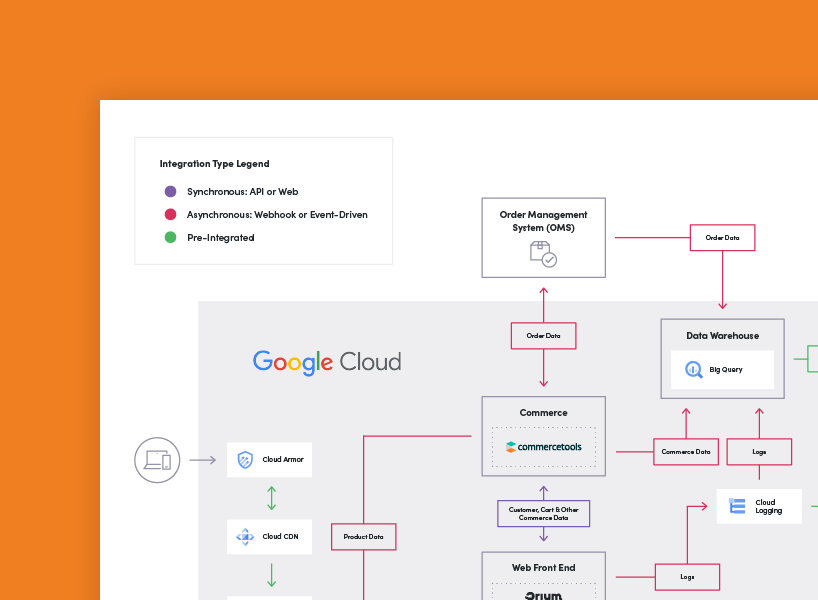
In other words, we should expect the architecture for composable commerce to vary to some degree from one organization to another. However, this reference architecture serves as an excellent starting point for understanding how the various pieces fit together in a composable commerce ecosystem. And with that said, let's dive in. Looking at this diagram, I would like to draw your attention to a few key elements.
00:12:18:06 - 00:12:46:17
First, let's take a moment to notice that everything shown here is running in the cloud. And in this case, many services on Google Cloud. This provides the environment for all services to operate and integrate with one another in a streamlined fashion. Looking more closely, this reference architecture captures the major services involved in composable commerce. We have up in the middle over here we have commercetools, which is our commerce engine.
00:12:46:19 - 00:13:22:14
This powers functionality around the product catalog. The cart and customers working hand-in-hand with commercetools as the checkout and payment services, which provide functionality to optimize the checkout experience. Further up, we have the Order Management system, which serves as a source of truth for all orders, fulfillment and returns. Down here, we have the Content Management system, where business users and Marceters can easily create and publish content without the need of developers such as landing pages, blog articles, and much more.
00:13:22:17 - 00:13:49:11
We also have a search engine which indexes all products and provides personalized search results on the website. There's also a Customer Experience platform, which provides key insights on customer behavior to optimize the customer experience. And we also have a data aggregation and visualization tools. BigQuery and looker. In this case, these services collect data from multiple sources and provide a comprehensive view of the entire business.
00:13:49:13 - 00:14:11:10
And finally, sitting in the middle of it all, we have the web frontend, which powers the actual ecommerce site. In this case, the frontend is powered by Orium's commercetools Accelerator, which is pre integrated with commercetools Search, the content management system and payment providers, and more or accelerators is the focus of my work, and I have a lot more to say about it.
00:14:11:17 - 00:14:39:03
So let's dive deeper in the next slide. Speaking of the web frontend, in this case the awesome commercetools Accelerator, I'd like to touch on two topics its importance within the architecture and what features the the Accelerator includes. Once you have your microservices correctly set up and configured, including commercetools, almost every functionality your brand might need is instantly available through APIs.
00:14:39:06 - 00:15:01:26
Therefore, most of the developments a brand will undertake will be building out the desired customer experiences on their website. And that all takes place in the web frontend. The web frontend is what customers see and interact with. For this reason, it's important that the frontend, as fast as appealing designs is accessible and is optimized as much as possible.
00:15:01:29 - 00:15:30:11
These factors directly influence the customer's experience and in turn, business outcomes. For brands just stepping into onto their path to towards composable commerce. Making the right decisions can be overwhelming. These decisions include determining which MACH services to acquire. How to integrate them with one another. Which technology stack should power the frontend and the best practices to follow when developing customer experiences?
00:15:30:13 - 00:16:02:02
Brands also need to consider optimization for SEO and site speed, among other things. This is where Audience commercetools Accelerator comes into play. It's the solution to all of these problems. The accelerator is designed specifically to fast track a brand's journey into composable commerce. The accelerator is integrated with several services, including commercetools, CMS search, checkout, payment providers and is fully customizable to cater to the most complex omnichannel customer experiences.
00:16:02:04 - 00:16:40:15
The accelerator also includes an experienced design system starter that includes Figma for design, collaboration, theming capabilities, UI components, and accessibility features. It empowers designers and developers to create consistent and visually appealing interfaces. The accelerator is fully customizable. It is built on top of years of experience and best practices to enable any customer experience. Additionally, the accelerator includes comprehensive developer documentation which helps developers get onboarded and trained, allowing them to become productive much faster.
00:16:40:18 - 00:16:55:08
Combined with Corning's team of experts, the accelerator helps de-risk the journey to composable commerce by offering an excellent starting point. Reducing time to Marcet and empowering brands. From day one.
00:16:55:10 - 00:17:09:14
And with all that said, we conclude our presentation the next slide. And next up is our highly anticipated fireside chat. So let's jump in.
00:17:09:16 - 00:17:37:14
Okay, so let's start with the first question from Marc. We are hearing more and more about composable commerce, commercetools and many new technologies entering this space. But why now? Why is there a shift towards composable commerce at this time? And what are the key business imperatives driving this change? Yeah. So over the last ten years, we've seen a big shift in consumer behavior.
00:17:37:16 - 00:17:58:19
Enterprises have struggled to adjust to do shopping preferences and the addition of diverse digital channels. Additionally, online revenues expand at a pace of four X over projections, and its infrastructure and operations were under pressure to keep up. So with this constant state of change, it requires technical agility to meet these demands, and older technical architectures and methodologies just weren't built for these shifts.
00:17:58:22 - 00:18:19:22
And quite frankly, they're struggling to manage it with true composable commerce offers a modern approach towards commerce solutions. And we're finding many brands are responding positively to this approach. So when we talk about a true composable commerce services, we're looking for cloud native solutions that are scalable, resilient, adaptive to change. They have independent components that can be quickly and easily interchanged.
00:18:19:25 - 00:18:38:08
And they're tech agnostic. So your developers don't need to be retrained to use it. Additionally, each brand has a different journey with varying needs. This is not a one size fits all world. And composable commerce allows them to create the right solution, leveraging the best of breed offerings to create exactly what they need today, while being flexible to whatever might come tomorrow.
00:18:38:11 - 00:18:54:14
See, that's the thing, right? We really don't know how things are going to look a year or two from now. Six months ago, nobody was talking about generative AI, and now everyone is looking for ways to leverage it. A compulsive solution will enable you to pull in new technologies and differentiators when it makes sense for you to do so.
00:18:54:17 - 00:19:13:13
Thank you. Thank you Marc that. Thanks for sharing your insight. Next question is for Rob. With the cloud as a foundational piece of the architecture, as we discussed today, what are some key benefits for Google Cloud in the context of composable commerce?
00:19:13:15 - 00:19:18:04
Thank you. You.
00:19:18:06 - 00:19:38:25
Get the hang of this, remote work thing one of these days. Yeah. Big reason customers choose Google Cloud is the flexibility. So the platform is a good fit for solution like commercetools. I represent a broad swath of ISV partners in our ecosystem. Like I mentioned before, and commercetools ranks at the top with regards to its native cloud infrastructure.
00:19:38:27 - 00:20:05:29
This allows for many optimizations that would otherwise be unavailable, leading to more efficient deployments, which of course translates to lower overhead. Not to mention the ease of managing the solution. Also, with Google Cloud's history of cloud native API microservices innovation and how we're part of Marc as an enabler, all reinforces this composable approach, which introduces more agility and flexibility that allows for new commerce experiences later.
00:20:06:01 - 00:20:31:23
And finally, Google Cloud has a strong history of data analytics and AI innovation, which is instrumental in helping countries look to improve both the customer facing side and the operational side of commerce. All right. Thanks a lot, Rob. Back to you, Marc. When a brand is looking at their current state and desired future state with composable commerce, the journey can seem overwhelming.
00:20:31:25 - 00:20:54:07
How can brands evaluate and plan for a move to a modular platform built on Marcet principles? Yeah. Brands really need to ensure they're solving problems for today, but in a way that's flexible for tomorrow. So it's doing a proper vetting cycle and ensuring your needs are going to be met throughout your journey. And the first thing a brand needs to do is to understand where their pain points occur in their current solution.
00:20:54:10 - 00:21:15:00
And for some, this might be like a single piece of the puzzle, like a non-performing search. Others might have more fundamental issues like site scalability, lack of omnichannel support, or other missing and critical functionality. And either way, the beauty of composability is that you don't need to change everything all at once. We recommend you start by addressing your biggest pain point first and leveraging a possible solution to solve it.
00:21:15:03 - 00:21:36:11
And then innovation can be incremental. You can once you get your first one resolved, you go to the next one with services like commerce, tools, composable commerce. You can consume any subset of APIs independently. And once you've resolved that pain point, you can expand your API consumption to solve another problem, or you can add another composable product into your ecosystem that's a better fit, best fit for a different specific need.
00:21:36:14 - 00:22:10:02
I absolutely agree with you there, Marc. And in addition to your points, I'd recommend brands start small. Our whitepaper highlights this triangular approach, which is describes replacing one functional area at a time. Brands should focus on areas they are experiencing the greatest pain. As you mentioned, and even where there are missed opportunities, for example, a brand may have an unstable checkout flow that breaks during high traffic periods or be restricted with the payment options they have or the loyalty programs that enables on their checkout experience.
00:22:10:04 - 00:22:36:11
And so targeting the checkout experience as an example, a brand can keep their entire existing infrastructure intact while only replacing the final checkout screens. There are so many benefits in taking this approach. Brands can establish a foundational architecture for that desired future state. They can anchor key technologies like commerce to those at Google Cloud, and they can obtain real, tangible results in a much shorter period of time.
00:22:36:14 - 00:23:06:23
And then with the change management within their organization, which significantly de-risk their transition. Following that. This question is for Rob. We've seen how the cloud has a crucial role in composable commerce. And for many brands still operating with monolithic platforms are sometimes painfully managing on-premise infrastructure to support their operations. How can brands effectively transition to the cloud?
00:23:06:25 - 00:23:41:14
And what are some of the benefits or downsides of going to the cloud? So the common value proposition of going to the cloud over utilizing on premise infrastructure applies just as well here as with any solution transition like that. As I mentioned prior to my work with partners, I was in a customer facing role. So with both partners and customers making a move from on premise to the cloud, we generally recommend the same multi-step approach that's lifting and shifting suitable applications first, followed by modernizing and re-architecting the solution for the cloud.
00:23:41:17 - 00:24:03:17
All the aforementioned benefits are realized by the end of this process, but there's still value in that middle step with a simple lift and shift regarding cost savings, reliability, and solution management. So in short, the ideal end state is going to be the most efficient and cost effective. But both states provide benefits over on premise. As a cloud evangelist, it's difficult for me to provide some of the negatives here.
00:24:03:17 - 00:24:29:26
Requesting. But there are some common objections, such as heavily customized infrastructure which do have merit. Some other ones we commonly hear, such as security control over infrastructure, difficulty of transition. These types of issues are easily countered with a variety of evidence to support that move to cloud. Thank you. Marc, we've heard that composable commerce unlocks business agility.
00:24:29:29 - 00:24:58:00
How have you seen commercetools make brands more agile and be able to quickly pivot to introduce new customer experiences? Yeah, I mean, moving to composable commerce is the best architectural way to reduce business risk and increase operational agility. And as we talked about in the presentation, the three key benefits of composable commerce are infinite scale, unlimited flexibility, and lower cost with infinite scale, opening up new regions and Marcets and ensuring you don't need to stress about increased or peak time customer load.
00:24:58:02 - 00:25:20:29
And the cloud native services automatically expand to your increased demand. API connectivity offers true modularity and unlimited flexibility. And with this, customers can release new features and functions faster and build long term value by swapping components in and out. You can create unique shopping experiences by easily combining, integrating, and extending APIs within your technical stack. And of course, the benefits of lower costs are built.
00:25:20:29 - 00:25:43:02
Self-explanatory, but you can achieve this through only paying for what you currently need. With composable, you can always add more when your demand increases. And we've seen that building commercetools based composable commerce solution increases developer productivity by up to 75%, along with decreasing maintenance costs by 50%. So you're spending less time keeping what you've got running, and you've got more resources to innovate and differentiate.
00:25:43:16 - 00:26:09:09
That's great. Thank you. Marc. Rob, over the last two years, we've witnessed a significant increase of microservices entering the Marcet. And especially on the Google Cloud Marcetplace with so many options available. How can brands make sure they're making the right selection that meets the needs of all stakeholders, including business users and customers? So the same advice I'll give here applies across pretty much any industry.
00:26:09:24 - 00:26:41:22
But discovery is critical. Before diving into any solution and mapping out all the technical and business requirements like really digging in. Super important to ensuring a successful deployment. I've seen too many folks rushing into buying a solution without fully mapping out all the requirements, which results in dissatisfaction at best, or a failed launch at worst. Google teams and GCP plus our partners have a variety of tools to assist with that process and mapping, and I recommend making sure to take advantage of those early and often.
00:26:41:25 - 00:27:04:15
I totally agree with you. There. Following on that Marc, you've seen how composable commerce introduces some changes to how business users and product managers conduct their day to day activities. How can brands effectively prepare their teams for these changes? And what do some of these changes look like? I mean, it's worthwhile to note that composable commerce is a technological paradigm shift.
00:27:04:27 - 00:27:21:12
So you don't have to get buy in across your internal organizational structures. You have to educate your internal teams. And that's going to be a key need to this point branch and really focus on getting all teams involved with the process as early as possible. Things like vendor selection should be a joint effort between business and partner product teams.
00:27:21:14 - 00:27:46:02
And the composable ecosystem is rapidly growing with new technologies, innovations and vendors. And get so gathering all these perspectives is going to be key to making the right decisions. I absolutely agree with you, Marc. And on top of getting buy in from these teams. In the white paper, we dig a little bit deeper in the roles and how developers, product managers and business users how their roles change with composable commerce.
00:27:46:04 - 00:28:08:24
By and large, internal brand stakeholders are enabled and empowered to do things they either couldn't do before or took much longer to do. For example, business users are empowered to create and publish content, landing pages and much more quickly without even needing developers. Product managers no longer need to wait for their commerce platform to release new features to create new customer experiences.
00:28:08:25 - 00:28:37:21
They can now just build anything they can dream of. And developers become much more focused in their areas of expertise, which leads to more optimized experiences. They're not learning how to customize inflexible platforms anymore. They're not trying to maintain complex homegrown solutions. They are now instead entirely focused on developing customer experiences and taking advantage of all the built-in functionality of Marcet services like commerce, tools.
00:28:37:23 - 00:28:48:17
Overall, this encourages more cross-functional collaboration within the organization and a more agile approach to reach the brand's desired outcomes.
00:28:48:20 - 00:29:09:21
Question back to you, Marc. Or actually, for the both of you. Are there circumstances where composable commerce is not the ideal solution? And when do you absolutely need to consider composable commerce? Yeah, I mean, there certainly is no solution. Works for all use cases. I mean, we've seen Shopify is an excellent solution and it works great for some brands.
00:29:09:24 - 00:29:32:03
But we've also seen where companies just outgrow that offering. So I'd say if you've reached the point where you're spending more time configuring and working around your current solution than creating your brand's differentiating features, that's when you know you're ready for composable commerce. Good. Yeah, I agree with all that. No solution will fit 100% of customers, and that comes down to a new amount of factors.
00:29:32:05 - 00:29:52:18
So I can't say there's any universal framework that will guide you on when or when I'll, move in this type of solution as ideal. But I will say, however, go into the cloud and composable commerce offers flexibility for both small and large shops, and it can grow with you regardless of where you're starting from. Interesting. Another question for the both of you.
00:29:52:25 - 00:30:13:26
A big concern for retailers today is Marcet uncertainty. With that in mind, is it a good time or a bad time for brands to start a composable commerce journey? Right now? Yeah. I mean, there really isn't a bad time to start. Composable commerce by nature allows for small step adoption. So in times of Marcet volatility, brands have the ability to adapt faster.
00:30:13:28 - 00:30:40:28
And composable commerce empowers them to do all that at their own pace. We've seen brands have major improvements in TCO and delivery agility that will allow them to scale, innovate more quickly and more powerfully. So in times of uncertainty, uncertainty are also potentially times of opportunity. If you are prepared, yeah, being able to react to industry changes rapidly is what many businesses are able to already do these days, especially with the advent of AI assistance becoming more and more prevalent.
00:30:41:00 - 00:31:02:06
These changes aren't slowing down. They are exponentially increasing. This volatility is not going away anytime soon. Your competitors are already doing it, so if you are, you'll be left behind. I recommend starting the journey to the cloud yesterday, but I also recognize that not everyone is ready to move right away. I will say though, it's never too soon to start thinking about it and planning ahead.
00:31:02:09 - 00:31:26:11
Okay. Yeah. That's great. Thank you. Lastly, what advice would you give technology leaders who are considering composable commerce or just at the beginning of their journey? The question for the both of you. Yeah, I mean, I'd say start with by talking with your internal and external stakeholders. Learn where you need to improve. Identify where you're stuck due to your current commerce solutions and then prepare.
00:31:26:13 - 00:31:46:19
Get buy in from your leadership teams, your product teams your development teams. And then create a plan of action that's in line with your company goals. I mean, it's definitely a journey, but I think it's one that's well worth it. I've kind of like I just said a moment ago, so get in touch sooner rather than later with your SI partner and or Google account team.
00:31:46:21 - 00:32:16:07
Okay. Yeah. And tagging along I would say come talk to us. You know, composable commerce is literally all we do. Orium. And we specialize in developing strategies to reach, you know, the brand's business goals. And, you know, my advice is, you know, just get in touch with us. Okay. And with that said, I think we're just at the end of our fireside chat and we're ready for the final section of our webinar, which is our audience Q&A.
00:32:17:04 - 00:32:42:28
Please submit your questions in the chat and we'll be happy to answer them. I think we have one question right now. Let me just pull this out. So question goes as follows. We've been hearing so much about AI and generative AI. How do you see this affecting commerce in the years to come? Yeah. Rob, you want to take this one first?
00:32:42:28 - 00:33:05:29
You want me to, I'll just add some some information from what I've seen. And since I support such a large number of ISVs, almost all of them are starting to integrate this technology in some form or another. I know it sounds like a really big and crazy new technology, but some folks are doing really big and crazy interesting things with it.
00:33:05:29 - 00:33:29:03
But there's a lot of stuff you can do at a much more functional level, whether it's just like leveraging some of our LLMs with large language models to do more basic, assistance with a lot of retail associated things just to speed up processes, help your employees. So I wouldn't be scared by diving into the general pool.
00:33:29:03 - 00:33:47:18
I would at least start poking around, see what's out there, and talk to us or your partners, because a lot of people are starting to leverage this, and it's not as complicated as a lot of folks might think, although there are some pretty cool and interesting things that are going on out there, you can still use it for pretty basic stuff to.
00:33:47:21 - 00:34:12:06
Yeah, and I think I'm going to pick up on that. Rob is I think what we're going to see here is, is multiple avenues of where AI is going to be, implemented within an organization. And the brand first thing you're going to see is probably operational improvements, things like, writing briefs, helping just documentation, things where it's, a lot of writing in generative AI and LLMs are going to be really beneficial into helping make that more efficient.
00:34:13:06 - 00:34:32:03
And then what you're going to start to see is kind of the scope is going to expand out where I think products are going to look to try and implement those, operational improvements in some way, shape or form. We've seen conversations around auto generating descriptive fields or auto translating for different cultures and languages. Then then it's going to get to bigger scale functionality and what that looks like.
00:34:32:05 - 00:34:49:14
I'm not sure that anyone really, really knows yet. I think that's kind of the genius of it is it's it's kind of wide open, it's new and it's going to be a lot of exploratory space. And here's where, again, composable commerce is going to be great because somebody is going to come out with the next genius thing that leverages AI, that we don't know what it is yet, and you're going to be ready to just pull that in.
00:34:49:17 - 00:35:26:26
Yeah. And all of that. I think one of the strengths of composable commerce is the plug and play nature of it. And we today is it's generative AI. Maybe in five years from now it'll be something completely different. But in the way that composable commerce works and the way that it's modular and and its architecture, we can just pull in whatever it is that comes through, whatever is evolving in the industry, and we can pull that in and integrate that directly into, the entire solution, at least a lot easier than, with a monolithic platform or a homegrown solution.
00:35:26:29 - 00:35:51:26
Okay. Another another question from our audience. What's the timeframe you can expect to move from a current platform to composable commerce? Marc. And believe that one. But, help. Definitely able to chime in a little bit, but I'll let them start. Yeah. I mean, I think, I think going back to what David mentioned earlier is, is, you know, you can start small.
00:35:51:29 - 00:36:10:29
The timeframe can be really, really quick. If you're starting with the right pieces. You don't have to change everything all at once. It's a journey. And you could pick and choose your biggest pain points first. So, you know, you can integrate because it's API driven. You can take something, for possible product and bring it into your ecosystem, you know, functionally, within hours.
00:36:10:29 - 00:36:29:26
But of course, you're going to want to really test that and make sure it's aligned to your brand overall goals. You know, I had we've had some stuff that we tinkered with internally that we could stand up in in an hour or two, just because, I mean, yes, we have the expertise to its APIs. And once you've got that API behavior and your development team pulling in new APIs is very, very straightforward and simple.
00:36:29:29 - 00:36:47:00
Now the what that looks like from start to finish when replacing maybe all of your ecosystem with composability, it's going to be much longer than that. Obviously it's like maybe hours. It'll be it'll take time and it depends on your brand, and your organizational maturity for that perspective. This is where partners like Orium and Google can help out to.
00:36:47:03 - 00:37:07:03
And I'll add that since I work with a number ISV, as I've said that a bunch, but, just reiterating it. I've seen deployments with commercetools. The other ISV and commercetools has the flexibility to do the bit by bit implementations. I've seen success with them going that route. But I also wanted to highlight the ability to do a more full scale replacement as well.
00:37:07:03 - 00:37:31:28
So it's something that we've been working on with Orium and a couple other ISV as well for a more fully encapsulated solution. So I'd encourage looking at both avenues to, you know, maybe replacing certain aspects of your solution today or augmenting whatever you have on site. But I wouldn't immediately discount the ability to to do like a full immersion diving in and getting a solution up and running as quickly as possible.
00:37:31:28 - 00:37:55:19
It might be a little bit more painful at first, because it's like a full rip in the band off kind of thing. But I guess part of the beauty with solutions like this, composable solutions is that you can choose one way or the other. But just wanted to highlight that, that we are trying to build out some more full scale solutions, with multiple ISV partnerships supporting all aspects of the retail journey.
00:37:55:21 - 00:38:18:03
Yeah. It's great. I totally agree with you guys. There. I have another question from our audience. Within an organization who typically leads the charge for digital transformation, typically as a, as a keyword here, I don't know that it's any one role. I think we've seen it kind of across the spectrum. And I in an ideal sense, it'd be a combination of the business and technical sides.
00:38:18:03 - 00:38:32:23
I mean, if you think about it, what you're really seeing is there's a business pain points that are causing a need for transformation. Whether that's need to move to multiple channels and you don't have support for or you're just not able to scale to where you demands are meeting, or you're not able to adapt quickly enough to new innovations and new features.
00:38:32:23 - 00:38:52:24
So the business person's got to be the one internally kind of saying, I need change. And then typically it's up to them, the technical side, whether that CTO or product or data officer or somebody in that regard who's out there exploring solutions and looking to see what's in the landscape that might that might fit the bill. And this is where we tend to have, you know, composable comes into play and you start to say, okay, then what's out there?
00:38:52:26 - 00:39:12:01
What products in the composable ecosystem are going to actually get me to where I need to go? And then it's a vetting process. So I don't know that it's any one person. I think it's a combination of multiple roles. No I you know, given that I'm an engineer, a lot of the stuff that comes to me when I'm, when I'm supporting a partner is going to be more on the technical side.
00:39:12:01 - 00:39:31:15
So often I'm working with folks that are investigating new solutions because their existing solution is starting to fail them. So these larger monolithic on premise solutions are just kind of like getting the whole as a person start breaking down over time. And, you know, that's harder to upgrade and keep up with everything. So then they're like literally just like, we need help.
00:39:31:17 - 00:39:52:18
What can we do? And that's like when, you know, we need to actually, like physically, technically need to make a move to a more modern technology. But what I've seen some challenges there when it is led from the technical side, is the business side, because they might be making this move because they're like running around with like a data center on fire or something.
00:39:52:18 - 00:40:08:19
And, but the the business users have no idea that there's a need to make the shift. So it's super important that they're involved in these conversations too, because they're the ones that are going to be the end users on it. And, you know, if they're suddenly getting a new solution dropped in their lap, it could really interrupt their workflow.
00:40:08:19 - 00:40:38:05
So no matter where you're starting from or the reason for making the move, it's very important that all the parties are invested because it's going to affect everyone's day to day work lives, no matter where they are in that spectrum. Yeah, absolutely. Agree. We have another question. So how does composable commerce connect to brick and mortar retail success, if at all?
00:40:38:08 - 00:41:01:05
I mean, composability, composable commerce is, you know, so if you have your website, your a mobile applications, your you can have in-store kiosks or or customer advocates from the store connected to the same common outcome and backend. And that's part of the beauty of the omnichannel approach is, is, is the APIs are consistent. And then you build your, your visual experience or UX on top of that.
00:41:01:05 - 00:41:17:11
And the channel is going to dictate what the UX looks like, but the backend is all going to be consistent. It's all going to be common. You make a change in one location. It's going to be propagated to all other locations. So yeah, I mean, I think how it does is, is it's just part of the nature of how it works.
00:41:17:25 - 00:41:48:21
And then what channels you want to enable leveraging the APIs that are available? Yeah, the flexibility is key there because you can push out these interfaces to all different avenues. And if you're partnering with some other ISV that can do more like signal pick up and then Marceting and identity resolution and mapping across all these different channels, you can really build out like a full scale omni channel solution where you're pushing, you're getting data in real time, and you're interacting with folks in the store, even in real time.
00:41:48:21 - 00:42:05:18
And then that's kind of the beauty of of all this cloud stuff working together. And just to pick up on that one more, there's going to be new channels that are introduced all the time, right? We saw the Apple iSight, the AR interface. I mean, that's not mature enough yet yet, but it's going to come and that's going to be a new channel experience.
00:42:05:24 - 00:42:21:13
You're going to have, you know, in some in some countries, social commerce is is a big thing. Maybe not so much in the, in the US, but but if maybe that gets introduced in the US and it takes off and then you've just got again, you've just connected to these new channels almost effortlessly. Absolutely, absolutely.
00:42:21:13 - 00:42:44:13
And we've seen the change happen over the last few years, especially as, you know, online sales grew, and retail operations. So, you know, you know, went down a little bit during the pandemic. But we do see a lot of use cases for, buy online, pick up in store, reserve online, and, you know, pick up in store, buy online, return in-store.
00:42:44:18 - 00:43:19:03
There are a lot of opportunities to blend both retail and retail together. And composable commerce lends itself to that kind of of, multi-channel experience very easily. So question from the audience. What questions do we need to ask ourselves as merchants before taking the decision to begin the the composable journey? Yeah. I mean, I think the first question is, is, is does what I as does what I have work for me today?
00:43:19:20 - 00:43:34:07
I, we mentioned earlier, right. There are some companies that are going to be perfectly happy leveraging Shopify from now until the end of their, their journey. And that's okay. If what you have works. It's the question. The first question is, is does is it not working? And then the second question is, is what's the pain point?
00:43:34:07 - 00:43:50:25
What's the biggest pain point that isn't working? Where is that? Where does that live? And and then really it's like, okay, well then I can replace that. I can just take that out and put in, composable, product API and how I fix that problem. And then we move on to the next problem. So it's it's really it starts with introspection.
00:43:50:26 - 00:44:07:06
It starts with where's my customer? Where's my company's journey? Am I happy today is what I have is what I have today going to satisfy where I want to be five years from now? And and if the answer to both those questions is yes, okay. Nonstarter. You don't need to go anywhere. But most likely the answer to that is no.
00:44:07:06 - 00:44:23:22
And you're going to say, okay, well then what do I need to replace versus how do I get there? And then you start looking at what's out there in the ecosystem and you know, David, you mentioned the strangler pattern is pick out that one thing, that one pain point. Take that out. Move to the next. Absolutely. We have a follow up question from the audience.
00:44:24:08 - 00:44:57:00
We mentioned the term social commerce. Can we define that term? Yeah. Sorry. Yeah, that it's big in in the East China specifically is it's very big. Social commerce is very big. And when you think about that, as you think about, like, an Instagram feed or, any kind of social networking feed you're scrolling through constantly. Social commerce is, it's consumer driven behavior by scrolling through feeds and finding products and brands that are, like, engaging to you and, and, and that's not something that really has taken off here.
00:44:57:01 - 00:45:13:22
We've seen companies touch upon it. TikTok has tried it a little bit. I know that AWS has tinkered with it a little bit. Facebook tried it. It hasn't really taken off in the Western audiences. But it's been very, very successful in China and Korea and Japan and places like that. So, you know, will that take hold?
00:45:13:29 - 00:45:47:02
I don't know, consumer behaviors are very different. You know, globally and in some ways. The cool thing is with composable commerce, when it does take off, you'll be ready for it. You just it into another channel. And if I'm not mistaken, you're the experts on this. So correct me if I'm wrong. I think it also allows for in those scenarios you mentioned like completing like even a purchase within like go like there and like, they don't have to like they're all getting redirected to like a new external website and and starting all over.
00:45:47:02 - 00:46:04:02
Right. It's kind of like all encompassing. You're a hundred. Yeah, 100%. Right? Yeah. Essentially you're when you're purchasing within that application. So you're not launching out of context. You're staying in the context, you're adding to the cart you're purchasing. You're staying in that feed and scrolling scrolling. So and that's something is that something you guys can support as well?
00:46:04:04 - 00:46:28:09
That's not a question for me actually. I think yeah. I mean like, composable commerce is all about multi-channel experiences. And and as you mentioned, Marc, we have Apple's vision Pro coming out and we have social, commerce. That doesn't really matter which channel it's coming through. It's all possible. It's all working the same APIs and services and data in the backend.
00:46:28:12 - 00:46:52:11
So, anything's possible. Really? Yep. And, you just, I don't see another question for this one, but I think we jumped over one earlier. I know we're running up on time, but I see what I. Is there anything else on the horizon that retailers, specifically needs to be keeping an eye on for ecommerce? Yeah. Do you have any, comments on that one?
00:46:52:18 - 00:47:23:02
Marc, if you have something, immediately go ahead. Otherwise, I can chime in. Please go ahead. So I've been, like I said before, I talked a little bit about, how folks are getting their toes wet or diving all in and using gen AI for a variety of purposes, but some of the the more functional stuff I'm seeing are, are basically, features that we've been kind of doing with Google Cloud and Vertex AI and in our retail search, like for a while.
00:47:23:02 - 00:47:52:25
So it's not even new, but now we're underpinning it with the general, generative AI large language models, which is giving like basically it's like turbocharging the functionality. So things like chat bots, shopping assistants, search results, recommendations, that kind of stuff. It was all doing pretty good. We've been and I've been pitching AI since when I was on a customer facing role 6 or 7 years ago, but now it's like we've gone like hockey stick in terms of the functionality is ability to predict and help and interact with people.
00:47:52:25 - 00:48:12:03
Like it's almost comical thinking of the chat bots that I was pitching when I was in the customer facing role, and how bad they were at pretending to be a human. Now it's like it's hard to distinguish. So that's that's the way I see it. Kind of fitting in here. It's it's always been there and people have been using it, but now it's just like really, really good.
00:48:12:06 - 00:48:33:07
Oh yeah. Yeah. And I'll outside of I, I mean I honestly I don't have a crystal glass. I don't know what this is going to look like, but intrigues me. Specific to commerce experiences. I think the form factor has to get a little bit more, you know, day to day, if you will. But I think this in my brain, I can imagine some really cool experiences built around shopping experiences and.
00:48:34:13 - 00:49:05:22
Yeah, I totally agree with you that. Okay, does it seem like we have anything else in our audience? So we're just about to wrap up for today. We can finish on the last slide of our presentation. So I want to say thank you. Express my sincere gratitude to our speakers for your invaluable insights today and to you, our, our audience, for your active participation.
00:49:05:24 - 00:49:31:02
I encourage you all to reach out. If you're embarking on your journey to composable commerce, just starting out or have any questions, please, just reach out to myself, Marco or Rob. We look forward to seeing you on this exciting path, transforming your business and deliver superior customer experiences. Thank you. Thank you again for your time today and have a great rest of your day.
00:49:31:05 - 00:49:35:18
Thank you.
Meet Our Speakers

David Azoulay
Head of Product Engineering at Orium
David is a seasoned technical leader with over two decades of experience in product development and technical consultancy. He spearheads the development of composable commerce accelerators and actively engages in thought leadership within the digital commerce space.

Marc Stracuzza
Director of Portfolio Strategy at commercetools
Marc Stracuzza is the Director of Portfolio Strategy at commercetools, with 20+ years of product experience. He joined commercetools in 2020 as a Product Manager and holds a Bachelor of Science in Computer Engineering. Marc is a dynamic speaker and thought leader, known for his expertise in product strategy and innovation.

Rob Eaton
Cloud Partner Engineer at Google Cloud
Rob is a seasoned technologist with over 11 years of experience working as a solutions, customer, and partner engineer across Google Cloud and other areas of Alphabet.
Brought To You By
.png?width=140&height=34&name=OR%20-%20Orium%20Logo%20-%20Orange%20(1).png "OR - Orium Logo - Orange (1)")
Orium is the leading composable commerce consultancy and systems integrator in the Americas. We help evolving brands execute, scale, and adapt quickly across their commerce experiences. With over a decade of experience in creating custom digital programs, we work closely with best-in-class technology partners to bring modern commerce experiences to life as a member of the MACH Alliance.

commercetools, inventor of headless commerce, is a digital software provider that empowers organizations to embrace innovation and thrive by providing flexible APIs that enable an agile, customizable commerce infrastructure at scale. Relied on by some of the world’s most iconic brands, commercetools enables continuous innovation by connecting digital channels to physical stores, and optimizing every new channel, from in-car and video content to AR/VR and voice to IoT-enabled machines, as well as future devices yet to be developed.

Google Cloud accelerates every organization’s ability to digitally transform its business. We deliver enterprise-grade solutions that leverage Google’s cutting-edge technology – all on the cleanest cloud in the industry. Customers in more than 200 countries and territories turn to Google Cloud as their trusted partner to enable growth and solve their most critical business problems.