
WEBINAR ON-DEMAND
Breaking the Commerce Bottleneck
Your SAP Exit Plan Starts Now

SAP Commerce support ends in 2026. And every quarter between now and then, your legacy platform is doing more harm than good, draining resources, limiting agility, and slowing your teams down.
But modernization isn’t just about replatforming. It’s about setting your business up for a new era of digital commerce— one that’s shaped by real-time decisioning, AI-powered buying assistants, and composable technologies built for continuous change.
This webinar shows how retailers can confidently move off SAP before the deadline, without the disruption. Learn how to modernize your stack to support hybrid customer journeys, empower your team, and build experiences that adapt alongside your business.
What You’ll Learn:
- Why Now: What the 2026 SAP deadline really means for digital teams—and why kicking the can risks long-term competitiveness.
- Composable Commerce 101: How modular architecture reduces risk, boosts agility, and prepares you for whatever comes next.
- Mitigation Without Mayhem: Proven, low-risk migration strategies from SAP to composable that won’t break your business.
- Designing for AI & Agentic Journeys: Get ready for a future where intelligent systems co-create with your customers.
- What Great Looks Like: See how forward-thinking retailers are already building futureproof digital commerce foundations.
What You’ll Learn
- Why Now: What the 2026 SAP deadline really means for digital teams—and why kicking the can risks long-term competitiveness.
- Composable Commerce 101: How modular architecture reduces risk, boosts agility, and prepares you for whatever comes next.
- Mitigation Without Mayhem: Proven, low-risk migration strategies from SAP to composable that won’t break your business.
- Designing for AI & Agentic Journeys: Get ready for a future where intelligent systems co-create with your customers.
- What Great Looks Like: See how forward-thinking retailers are already building futureproof digital commerce foundations.
Show Transcript
00:00:00:00 - 00:00:31:20
Tori (Online Retail Today)
Welcome, everyone, and thank you for joining us for *Breaking the Commerce Bottleneck: Your Shop Exit Plan Starts Now*, presented by Online Retail Today and sponsored by **Orium** and **commercetools**. I’m Tori, the webinar coordinator for Online Retail Today, and I’m excited to bring you this session on how top brands are replacing legacy systems and preparing for AI-powered shopping.
00:00:31:22 - 00:00:51:22
Tori (Online Retail Today)
I’m looking forward to hearing from Jason Cottrell and Gireesh Sahukar in what I’m sure will be an insightful discussion. In case you miss any part of today’s webinar, we will be recording this session and emailing it to you within the next 48 hours. You can also go to the registration page to access the recording. We’re going to send that link in the chat right now.
00:00:52:00 - 00:00:57:07
Tori (Online Retail Today)
Up next.
00:00:57:09 - 00:01:26:04
Tori (Online Retail Today)
Before we go any further, I want to thank **Orium** and **commercetools** for sponsoring this webinar and helping us make it happen. **Orium** is a leading composable commerce consultancy and systems integrator in the Americas. They work with best-in-class technology partners to set strong composable commerce foundations that help brands serve their customers across channels. **commercetools**, the inventor of headless commerce, is a digital commerce software provider that empowers organizations to embrace innovation and thrive by providing flexible APIs—enabling agile, customizable commerce infrastructure at scale.
00:01:26:06 - 00:01:47:10
Tori (Online Retail Today)
So thanks again to our sponsors, Orium and commercetools. Up next, let’s quickly get some technical things out of the way. We will have a Q&A session with our panelists at the end of the hour. Feel free to submit your questions throughout the presentation using the Q&A panel located in the bottom toolbar.
00:01:47:12 - 00:02:07:18
Tori (Online Retail Today)
The chat is open for discussion and comments. Be sure to change the blue button in the chat box from “Hosts and panelists” to “Everyone” so you can join the conversation. Also, feel free to use the React feature when any of the content resonates with you. Please note that we will be using the Q&A panel for your specific questions, so make sure you put questions there (not just in chat) so they don’t get lost.
00:02:07:19 - 00:02:26:04
Tori (Online Retail Today)
My wonderful colleague Tara will be fielding your questions and comments today, and she’ll be happy to answer anything technical you might have. So go ahead and pull up the chat and Q&A panel to get familiar—say hello and let her know where you’re joining from. Closed captioning is available for this webinar. To enable this feature, select the “Show Captions” option.
00:02:26:06 - 00:02:49:12
Tori (Online Retail Today)
Lastly, if you have any audio issues during today’s presentation, you may choose to dial in by phone. All dial-in information can be found in your confirmation email from Zoom, and Tara can relay it to you at any point if you need it. Up next, I’m excited to hear from today’s panelists—so without further ado, I’m going to turn it over to them for quick introductions.
00:02:49:14 - 00:03:28:19
Gireesh Sahukar (commercetools)
Thank you. Hello, everyone—I’m Gireesh Sahukar, VP of Implementations, Customer Solutions, and Partner Success here at **commercetools**. I have a background in commerce platforms and commerce businesses for the past two decades—building, running, and owning ecommerce technology platforms, across the full IT side of things as well as the business and the P&L. So I’m happy to chat about how you can migrate away from your current monolith into a modern stack over the next 30 minutes.
00:03:28:21 - 00:03:51:21
Jason Cottrell (Orium)
Perfect—thank you. I’m Jason Cottrell, Founder and CEO of **Orium**. We’re a leading specialist in composable commerce in the Americas, and over the last 15 years we’ve seen a number of paths from SAP to more modern ecommerce platforms. I’m really looking forward to working with Gireesh to share some of those insights today.
00:03:51:23 - 00:05:38:22
Jason Cottrell (Orium)
As we were preparing for this session, Gireesh and I found we were getting more and more calls like: “I need to make a decision.” With support for some versions of SAP Commerce going away in 2026, many teams are thinking about what they’re going to do next.
Any change—staying with SAP or moving away from it—is a significant lift. Many leaders feel they owe it to their organization to look at options and consider what the benefits of more modern ecommerce platforms might be. And if they decide to change, the next questions are: how long will it take, how do we go about it, and how do we de-risk it?
So today, we’re going to touch on those topics. When you leave, our hope is that you’ll have clearer decision criteria that Gireesh and I use in conversations with brands, and a roadmap for how to approach the change.
From an agenda perspective, we’ll start with what’s actually going away—what the end-of-life or end-of-support reality looks like. Then we want to zoom out and talk about the substantial changes in customer buying behavior that are impacting both B2C and B2B.
We’ll talk about composable commerce—what it means, why it has become the default architecture for modern enterprise commerce—and then we’ll trace a few common migration paths, with pros and cons and examples.
Finally, we’ll bring it all together: how do we ensure you’re prepared for AI and hybrid human/AI journeys? What systems support that? What do you need to think about? Any new system or upgrade starting in 2025 is going to live through the agentic era. Then we’ll wrap with Q&A.
00:06:00:10 - 00:10:10:06
Gireesh Sahukar (commercetools)
Thanks, Jason. And yes—the clock is ticking.
If you’re currently running SAP Hybris or SAP Commerce, you likely know that version 2205 has an end of life in **July 2026**. End of support means you’re facing a critical deadline: you have to make a decision.
We’re having a lot of conversations about this with many users of that stack. It’s more than just a date—it represents a significant risk to your commerce business. Not only are you looking at a future without security patches, updates, or support for emerging threats (which risks your broader technology infrastructure), you’re also looking at a future where—without changes—you’re stuck with a complex legacy monolith that isn’t easy to work with, and isn’t very agile or flexible.
Teams spend a lot of time, energy, and resources building capabilities just to react in a timely fashion to market changes and evolving trends. That drives both business and technology challenges—your CMO, CRO, and CIO all feel it.
And the cost of staying with that stack is not zero. You still have significant operating costs, plus licensing and support costs—while risk goes up and you may not be delivering net-new business value for those additional costs.
I think we want to put up a poll here to see what your organizations are doing to get ready for the 2026 deadline.
00:08:56:19 - 00:09:31:00
Tori (Online Retail Today)
Thank you very much. The poll should pop up on your screen. We encourage you all to submit your responses: **How prepared is your organization for SAP Commerce’s July 2026 end of support?** We’ll give you a few seconds to submit your answers. We’d love to get a pulse for where the audience is at so we can tailor some of our upcoming commentary.
00:09:31:00 - 00:10:10:06
Tori (Online Retail Today)
Okay, I’m going to go ahead and close out that poll and share the results. That’s great—and thanks to everybody who participated.
00:10:10:06 - 00:18:39:18
Jason Cottrell (Orium)
So, some thoughts as we consider options for commerce in your business. One of the things we’re speaking with customers about frequently is: what will recent advancements in AI mean for platform selection going forward, and how will that change customer behavior?
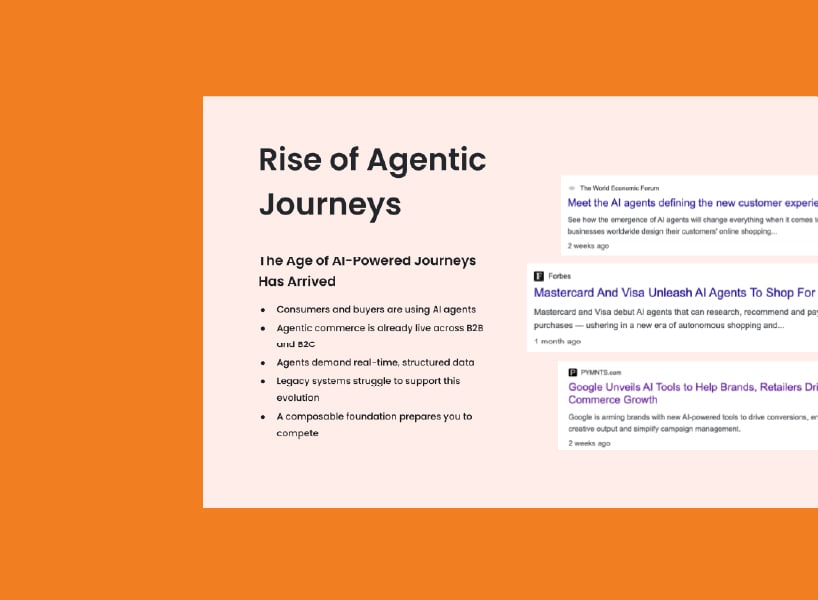
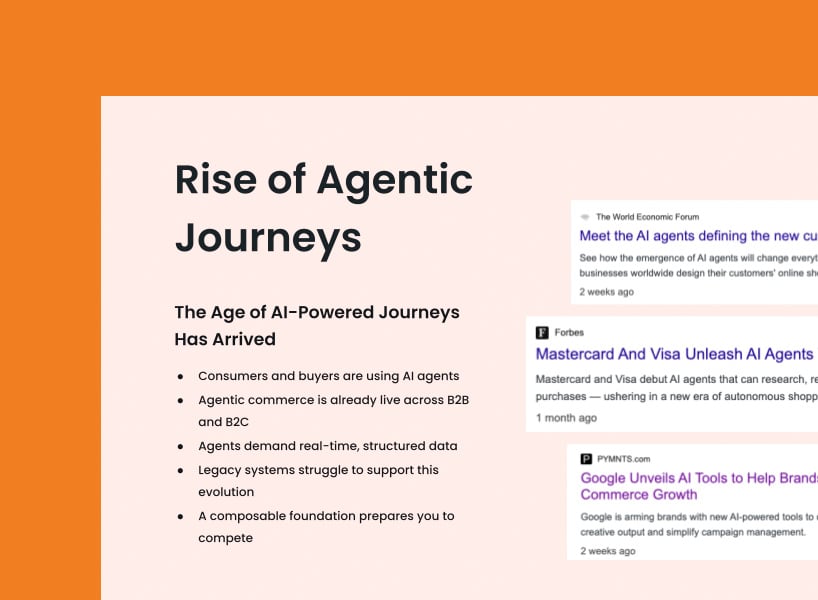
There’s both risk and opportunity here; let’s focus on the opportunity. What we’re seeing is an opportunity to meet customers as they increasingly use agents—for research, product selection, and deciding where to buy. Think ChatGPT, Perplexity, or Gemini. And increasingly, over the last few months, many providers have rolled out or are piloting instant-purchase capabilities—so the customer doesn’t even have to transition out to your website.
We’re seeing this trend first in B2C, but we expect it to follow quickly in B2B, as consumer trends often flow into the workplace. This is a very real change: some companies are seeing substantial shifts in web traffic—drops in site traffic or shifts in traffic sources.
We’re reminding customers that the criteria for being included in these listings—and being recommended as “the place to buy”—are different when an agent is involved. Performance matters. Data matters. API access and verification matter. It’s setting a new set of criteria for how to thrive in commerce going forward.
On the B2B side, imagine not only human purchasing patterns, but purchasing agents, replenishment agents, and procurement agents. This becomes another channel—another endpoint (or multiple endpoints)—that your commerce platform has to support. It’s also likely to play a role for your own internal agents, customer service operations, and business workflows. Those systems need access to many of the same points of data and control.
If we think about moving off SAP: while the product has improved its ability to operate with third-party providers, overall it’s comparatively rigid and complex. The cost to add something as simple as an additional payment method in checkout is often an order of magnitude higher than what we see on modern, composable architectures. SAP Commerce was designed before many of these modern considerations were in play.
Composable commerce suggests a simpler approach: ensure you can have specific functions served by third-party vendors—and swap modules out as needs change. Search can be served by a specialist vendor; promotions, order management, or payments can be modular as well. This type of architecture readily serves more channels—including emerging channels like AI-assisted buying.
Benefits we see when composable is done well:
- Dramatic improvement in time-to-market
- Increased efficiency in development teams
- Better adaptability as market conditions change
I like to say: the only certainty over the next few years is change. We have customers on composable architectures who can start to support agent endpoints in weeks, not months or fiscal quarters.
To define the problem statement: when you think about the SAP Commerce codebase and when it was first created—late 1990s and early 2000s—that was before cloud architecture, before microservices were broadly used, and before RESTful APIs were standard. Many integrations were SOAP APIs. It was pre-iPhone, pre-mobile-dominated traffic. It can feel like a technology time capsule.
So what does composability and modularity mean, and why should you care? It’s more than just technology. Composable commerce is a modular approach for building and operating your commerce stack—but it has become prevalent because it allows businesses to create tailored experiences and solutions for their specific needs. You’re not limited to an out-of-the-box accelerator anymore.
You can select technologies that work for your business—not be forced to adapt your business to your technology. You can make technologies from multiple vendors work together via APIs, through loosely coupled systems, in a cloud-native and component-based way. And it’s technically agnostic: whether your teams prefer .NET, Java, Python, or Ruby on Rails, modern platforms provide APIs and let you keep using languages you already know.
00:18:39:18 - 00:23:54:00
Gireesh Sahukar (commercetools)
Jason, what does this do for the business?
00:19:39:01 - 00:23:54:00
Jason Cottrell (Orium)
It’s a great question. Our approach is “just enough composability,” as the business case supports. It’s not about having 20 different vendors for the sake of it—you need a simplest path with the smallest number of vendors, while preserving flexibility. Each vendor should meet a specific business need and have an ROI case.
If you implement search, there should be a reason—often performance and revenue uplift. Same with CMS: time-to-market, campaign speed, personalization. If the ROI isn’t there, we’ll try to collapse and simplify the vendor set until we find the sweet spot.
On the far side of moving to composable, customers no longer think in terms of “replatform.” Instead, they curate the platform. You can change individual elements to meet business needs and keep pace over time—without needing a massive CapEx replatform every few years.
Many vendors are also investing heavily in AI. Most customers shouldn’t be investing millions in bespoke AI; they should select ecosystem vendors bringing R&D and innovation to the table.
We also get asked: “Is composable for me?” Often, in enterprise settings, the reality is you’re already somewhat composable—because you’ve outgrown core platform components and brought in other tools. The challenge is that many legacy commerce vendors weren’t architected for easy integrations. You may not have performant, well-documented APIs. In contrast, many modern vendors have productized integrations, which dramatically reduces time, cost, and risk to assemble the stack.
Think of it like riding a bike through a snowstorm. You might get there on a retrofit architecture—but it’s more time, cost, and risk than on a stack built for composability.
That brings us to our next poll: we’d love to get a sense of the architecture you’re on today.
00:23:54:02 - 00:24:40:16
Tori (Online Retail Today)
We’re curious to know which best describes your current architecture. Go ahead and submit your responses—we’ll give you about 30 seconds.
00:24:19:17 - 00:24:40:16
Tori (Online Retail Today)
Okay, and here are those results. That’s great—and I see “hybrid” in there, which is often the reality. You incrementally evolve to meet business needs.
00:24:40:16 - 00:37:52:07
Jason Cottrell (Orium)
So, we promised the audience: what are the common ways these platforms transition? Often you’ve built up ten years or more of business logic and processes into your current commerce stack. Let’s talk through three common migration paths we see, and help you make sense of which might be right for you.
**1) Phased migration**
This is a gradual, step-by-step transition from legacy to new—like renovating a house room by room. Customers often start with search, CMS, order management, PIM, checkout, or even just PLPs and PDPs. They can take those incremental wins back to leadership with a targeted business case and clear ROI.
The downside is that on older deployments—especially older SAP or Oracle Commerce environments—integrating third-party services can take far longer than expected. Not 10% longer, but sometimes 2–3x. So expectation setting is critical: early steps can take longer until enough of the core stack is modernized and things start moving faster.
**2) Strangler pattern**
This is like adding a new wing to your house, living there some of the time, and gradually stopping use of the older rooms. You introduce net-new capability to a slice of traffic—maybe a region, guest users, or a small percentage of customers—and run services side-by-side. You might even run two checkouts for a period.
Advantages include additional time to clean up data issues, sync issues, or undocumented legacy logic—especially when the original builders are no longer with the company. It can also be less disruptive to the business. The tradeoff is additional complexity in maintaining both systems in parallel until you fully decommission the legacy stack.
**3) Greenfield**
This is building a new house on an empty plot of land. It’s often used when the current system is too messy, you’re entering a new market or line of business, or you want to start from scratch. You build “just enough” core capability to move in, then expand over time.
To bring this to life, Gireesh can speak to a greenfield approach from his experience.
00:30:20:06 - 00:36:43:05
Gireesh Sahukar (commercetools)
Greenfield is an interesting approach. Typically, you take a greenfield approach when your current system is messy, you don’t have one, or you’re entering a new market or new line of business. You start from a blank sheet of paper and build just enough capability—then add functionality over time as it makes sense.
That’s what a commercetools customer, Dawn Foods, did when I led ecommerce there. We took composable architecture insights and built a foundational B2B commerce site, then added capability over time as the business grew and customers asked for new features.
The advantage is you’re not building onto a legacy platform—you can pick and choose best-of-breed tools, start with zero technical debt, and adopt modern frameworks and practices. The challenge is higher upfront effort and investment, and a higher degree of risk, because it’s typically a big-bang launch: you flip the switch and it needs to work from day one.
There’s also change management: you’re moving teams to new tools and ways of working, and you need time for training and process updates. And you’re operating two major platforms side-by-side during the build period.
Those are some of the tradeoffs to consider in a greenfield approach.
00:36:43:14 - 00:37:52:07
Jason Cottrell (Orium)
Thanks, Gireesh. Tori, maybe we could post a poll on which of these approaches resonates most with the audience.
00:37:30:02 - 00:37:52:07
Tori (Online Retail Today)
We’ll give everyone a few more seconds to submit responses. Thank you. Okay, I’m going to go ahead and close out that poll. And here are the results—phased/strangler patterns seem to resonate, which makes sense given hybrid realities.
00:37:53:15 - 00:49:33:16
Jason Cottrell (Orium)
As we close out, I want to reiterate: if you’re making investment now, you want to ensure it isn’t outdated in 12 to 24 months. As humans and agents work together more actively—and new capabilities emerge to service agent endpoints—this becomes relevant within the next 12 months, not five years.
In guiding customers, we advise thinking competitively: it won’t just be “can you serve an order?” It will be “can you serve it faster than others, and provide information to the agent more quickly, packaged and organized?”
Foundational steps—data hygiene, structured models, well-documented API endpoints—take time. We want those foundations in place now. No matter how the “Game of Thrones” of AI plays out, having your data in order and your APIs organized will position you well—for customers and for internal agents that run your business.
There’s also a shift in how we build: we’re increasingly working from pre-developed frameworks and integrations, and using AI-assisted toolchains for planning and delivery. Some platforms support that paradigm better than others, including AI co-creation, code generation, UI/content generation, and personalization. That increases pace and adaptability, as long as governance and safe usage are in place.
We’re also seeing ISVs embedding AI into their products—CMS/DXP providers have significant AI capabilities, and AI-native search is emerging. Merchandising has been a longstanding machine-learning use case.
With AI embedded across providers, there’s a stronger spotlight on the data you feed into these platforms. The more product context you provide—size, color, fit, measurements, attributes, structured descriptions—the better agents and assistants can recommend your products accurately. Rather than building your own AI, your focus should be on exposing high-quality data in well-defined, structured models so these systems can function well.
Finally, it’s also an opportunity to rethink why people come to your direct channels: loyalty or membership exclusives, tailored fulfillment options, product customization, and interactive experiences that work best in a screen UI can still bring customers to you.
To summarize: there’s a decision to be made for many brands, and it needs to be made soon. This is an inflection point. We discussed the benefits of composability, why it will matter even more in the agentic era, and common migration paths. We hope this helps you make a decision and plan your move.
Tori, I’ll pass it back to you for Q&A.
00:49:33:16 - 01:03:12:00
Tori (Online Retail Today)
Thank you both for such an insightful presentation. Before we dive into Q&A, I want to remind everyone that now’s the time to get straight-from-the-source insight from today’s panelists. Great questions contribute to a great webinar, so don’t forget to submit yours.
Also, today’s session is being recorded and will be emailed to you within the next 48 hours. If we don’t get to your question today, we encourage you to connect with the panelists using the channels on screen (they’re also in the chat).
Okay—this first question comes from Cindy: *I’m worried we may be underestimating the effort involved in disentangling from legacy SAP systems. What are some common pitfalls when moving toward modernization from SAP?*
Gireesh Sahukar (commercetools)
When starting a migration from a legacy platform like SAP Hybris, you’ve often spent 10–15 years on it, and you’ve built many processes and frameworks around how it works. Start with: (A) your current business processes, (B) your current operating state and structure, and (C) how you’ve customized the technology to support that.
Develop your migration path from the requirements and current-state architecture. Disentanglement can be challenging—this is where documentation hygiene and understanding your existing processes is worth its weight in gold, even if you’re replacing small pieces in a phased approach.
There are also pre-built asset libraries and guidance from commercetools and **Orium** on how to do this. We encourage you to review those resources.
Tori (Online Retail Today)
Thank you. This next question comes from Scott: *Are there any quick wins retailers can implement now to reduce dependency on SAP without triggering a full replatform?*
Jason Cottrell (Orium)
A few common quick wins we see:
- **Search and CMS**: take more control of the experience layer.
- **PIM**: centralize product data in a dedicated PIM, or introduce a modern commerce platform catalog to serve experiences as an intermediary. It often surfaces gaps and improves data quality and structure.
- **Cart and checkout**: introduce a modern checkout/payment solution. This often has a direct conversion benefit and can support new wallets and payment methods more easily. You can also build resiliency with backup processing (for example, adding a secondary provider).
Gireesh Sahukar (commercetools)
I’d add: going headless for the experience layer is often the most popular “step one” for SAP shops. It decouples the frontend, gives more autonomy to the web development and content teams, and reduces reliance on the rest of the system—while letting you evolve other components over time.
Tori (Online Retail Today)
Thank you. This next question comes from an anonymous attendee: *What’s the best way to get cross-functional teams—especially IT—aligned on a modernization roadmap? And what does a modernization roadmap look like when moving assets out ahead of deadlines without disturbing peak retail seasons?*
Jason Cottrell (Orium)
This often comes back to choosing the migration path that fits your risk tolerance and seasonality constraints. If avoiding disruption during peak periods is critical, the strangler or phased approaches can be a better fit than a greenfield “big bang,” because you can deliver incremental value while moving toward a clear North Star.
Gireesh Sahukar (commercetools)
Working with an experienced partner can also help align business and IT. Implementation partners often bring accelerators and proven patterns that can load data and wire up API-based integrations quickly—giving an early read on scope, quick wins, and areas that will require more effort. If you’re trying to launch before holidays, an accelerator-based approach can be especially helpful; if you can launch after peak, you may have more time to deepen functionality and take advantage of modern platform capabilities (including agentic and GraphQL support).
00:01:02:26:16 - 01:03:12:00
Tori (Online Retail Today)
Thank you both for those thoughtful responses. It looks like that’s all the time we have for today. I hope you all learned half as much as I did. Again, if we didn’t get to your question today, you can connect with the panelists using the channels on screen, and they’re also in the chat.
Before we go, we’d like to encourage you to participate in the survey that will pop up in your browser after the webinar. This feedback helps us continue to produce the webinars that you enjoy.
Thank you to our sponsors, **Orium** and **commercetools**, and a big special thank you to our incredible panelists, Jason and Gireesh, for providing us with such valuable information. And a huge thank you to all of you for attending. I’m Tori, and I hope you have a great rest of your day and a great rest of your week.
Stay busy.
Meet Our Speakers

Jason Cottrell
CEO and Founder, Orium
Jason Cottrell is the CEO & Founder of Orium, the leading composable commerce consultancy and system integrator in the Americas. He works closely with clients and partners to ensure business goals and customer needs are being met, leading the Orium team through ambitious transformation programs at the intersection of commerce, composability, and customer data.

Gireesh Sahukar
VP of Implementations & Customer Solutions, commercetools
Gireesh Sahukar is VP of Implementations & Customer Solutions at commercetools, leading global customer implementations and partnerships. He previously led digital strategy at Dawn Foods and Keurig Dr Pepper. A veteran of startups, Gireesh was part of teams that built leading companies and technologies acquired by GE, Oracle and Accenture.
Brought To You By
.png?width=140&height=34&name=OR%20-%20Orium%20Logo%20-%20Orange%20(1).png "OR - Orium Logo - Orange (1)")
Orium helps enterprise brands move faster and stay ahead with smart, modern commerce solutions. With unmatched composable experience in North America and strong tech partnerships, we deliver scalable solutions that evolve with our clients. Blending AI, data, and composable systems to build adaptive experiences for people and intelligent agents, Orium is driving efficiency, agility, and long-term advantage.

commercetools is the leading enterprise commerce platform built to power innovation and versatility for the world’s leading brands. By removing the constraints of legacy systems, commercetools enables companies to innovate freely, personalize at scale, and quickly launch new channels to meet the evolving demands of their customers.